- Home
- Retail
- Retail Investors Resources
- 4 DFW Suburbs Where Retail Property Values Are Expected to Double by 2030
4 DFW Suburbs Where Retail Property Values Are Expected to Double by 2030
Key Takeaways: 4 DFW Suburbs Where Retail Property Values Are Expected to Double by 2030
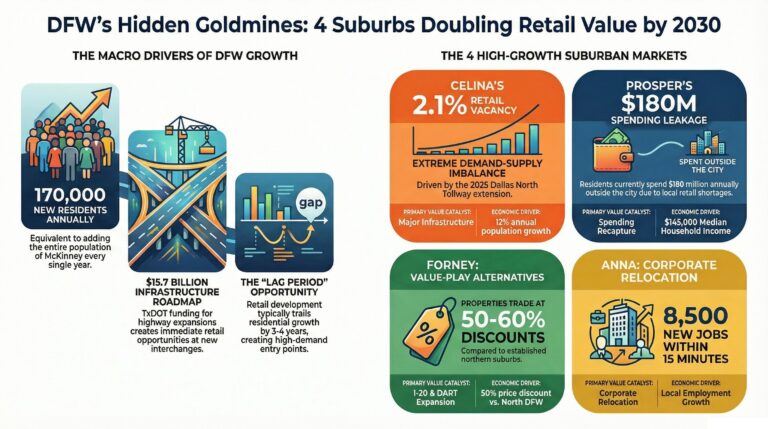
- Celina: 2.1% retail vacancy. Dallas North Tollway extension completing late 2025. Household incomes 40% above DFW average. 12% annual population growth.
- Prosper: $145,000 average household income. Current retail serves only 60% of residents. $180 million in annual spending leaving the market.
- Forney: Retail properties trading 50-60% below comparable northern suburbs. DART Blue Line extension planned 2028. Lowest land costs with fastest population growth.
- Anna: 8,500 new jobs within 15-minute drive. Average salaries exceed $85,000. Existing retail inventory below modern tenant standards.
- DFW Context: 170,000 new residents annually. $15.7 billion in highway improvements committed through 2030.
4 DFW Suburbs Where Retail Property Values Are Expected to Double by 2030
After nearly two decades of investing in retail real estate across the Dallas-Fort Worth metroplex, We’ve learned that timing isn’t about predicting the future. It’s about recognizing the patterns that others miss.
As commercial real estate investors ourselves, when we evaluate any retail property opportunity, we ask the same question we ask about our own investments: “Would I put my money here?”
The answer depends entirely on understanding where growth is heading, not where it’s been.
The DFW Growth Engine That Never Stops
While other major metros struggle with population decline and economic uncertainty, DFW continues its relentless expansion. We’re adding over 170,000 new residents annually, roughly equivalent to the entire population of McKinney every single year. This isn’t just raw population growth. These are families with purchasing power, moving here for high-paying jobs in technology, healthcare, and financial services.
But here’s what most investors get wrong: they chase the growth that already happened instead of positioning themselves for the growth that’s coming next.
The retail properties doubling in value by 2030 aren’t in the established wealth corridors of Preston Road or along the trophy retail streets everyone already knows about. They’re in those suburban markets that are about to transform from bedroom communities into retail destinations.
The Infrastructure Advantage You Cannot Ignore
Smart retail real estate investors follow infrastructure spending like a roadmap to future wealth. The Texas Department of Transportation has committed $15.7 billion to DFW area highway improvements through 2030. Every mile of highway expansion, every new interchange, every transit connection creates retail investment opportunities for those who position themselves correctly.
We’ve analyzed demographic shifts, employment patterns, and infrastructure investments across the entire metroplex using our proprietary systems and data resources. The data reveals four suburban markets where retail property values will likely double by 2030, driven by fundamental changes that are already in motion.
Market #1: Celina – The Technology Corridor Explosion
Celina sits at the intersection of massive infrastructure investment and corporate migration patterns. The Dallas North Tollway extension, completing in early 2026, will cut drive times to corporate centers by 15 minutes. When you combine this with median household incomes 40% above the DFW average and an eye-popping 26.6% increase from July 2022 to July 2023, according to data released May 16 from the U.S. Census Bureau., you get retail demand that far exceeds current supply.
The retail vacancy rate in Celina today is below 3%. New construction cannot keep pace with demand.
Corporate relocations are accelerating the timeline. When major employers announce expansions in nearby Frisco and Allen, their employees often choose Celina for the value and small-town character. Each new family represents roughly $65,000 in annual retail spending power. The math is compelling for any commercial real estate investor paying attention.
Market #2: Prosper – The Master-Planned Community Wave
Prosper represents everything that makes DFW retail investment attractive: controlled growth, high-income demographics, and strategic planning that ensures retail success. The median home price exceeds $600,000, median household income of $214,000 annually, and the population has tripled in the past decade.
But here’s the opportunity: retail development lags residential growth by 2-3 years in master-planned communities. Families move in, establish routines, then demand convenient shopping and dining options. The smart money invests during the lag period, capturing appreciation as retail demand peaks.
Our analysis shows current retail supply can support only 60% of current residents’ shopping needs. The remaining 40% drive to nearby Frisco or McKinney, representing $180 million in annual retail spending that could be captured locally. That’s the kind of supply-demand imbalance that creates exceptional returns for patient investors.
Market #3: Forney – The East Dallas Renaissance
Forney exemplifies the opportunity in DFW’s eastern expansion. Traditionally overlooked by commercial investors, this market offers some of the most affordable land costs in the metroplex while experiencing some of the fastest population growth. The combination creates exceptional value creation potential for patient investors.
Infrastructure investment is accelerating the timeline. The completed Interstate 20 expansion reduced commute times to downtown Dallas by 20 minutes. TXDOT has multiple infrastructure projects announced already expanding the major highways around Forney.
The more established retail properties here trade at 40-60% discounts to comparable northern suburbs, despite similar demographic profiles and growth rates. Early investors are positioning themselves for substantial appreciation as the market recognizes Forney’s transformation. This is the kind of opportunity that rewards investors who do their homework rather than follow the crowd.
Market #4: Anna – The Corporate Headquarters Effect
Anna benefits from two powerful trends: corporate relocations and highway accessibility. The recent Highway 5 expansion provides direct access to corporate centers in Plano, McKinney, and Allen, while rising construction costs push families east to more affordable communities.
Three major corporations have announced significant expansions in nearby employment centers, adding 8,500 jobs within a 15-minute drive of Anna. These aren’t minimum-wage positions. Pushing Anna’s median household income beyond $100,000 annually and creating substantial retail purchasing power that needs places to spend it.
The retail opportunity is immediate. Current supply consists primarily of older strip centers that don’t meet modern tenant requirements or customer expectations. New retail construction faces significant development challenges, limiting competition for existing properties. For investors willing to acquire and reposition these assets, the upside potential is significant.
The Investment Strategy That Actually Works
Successful retail investing requires more than identifying growth markets. You need to understand which properties within those markets will capture the value creation. Location within the community matters as much as choosing the right community.
Properties on the “going home” side of major thoroughfares consistently outperform those requiring left turns across traffic. Shopping centers anchored by grocery stores or medical services prove more recession-resistant than fashion retail. Parking ratios, visibility, and access patterns determine long-term success more than current rental rates.
My approach starts with demographic analysis, incorporates infrastructure timing, and focuses on properties where improvements can accelerate value creation. The best opportunities often look problematic to casual observers but represent solid value to investors who understand the fundamentals. That’s where the real money gets made in commercial real estate.
The Timing Element You Cannot Ignore
Commercial real estate cycles last 7-10 years compared to stock market volatility measured in months or quarters. This extended timeline allows careful analysis and strategic positioning impossible in other asset classes.
Current market conditions favor investors with patience and local market knowledge. Interest rates remain reasonable for quality properties. Property values haven’t reached the speculative levels that characterized previous market peaks. Demographic fundamentals continue strengthening across all four markets.
The opportunity exists today because most commercial real estate capital chases established markets with proven track records. By the time institutional investors recognize these suburban opportunities, pricing will reflect future potential rather than current fundamentals. The window for positioning ahead of that recognition is now.
Why This Matters for Your Investment Strategy
Every recommendation I make passes the same test I apply to my own investment decisions: would I invest my own money in this opportunity? The four markets outlined here meet that standard based on demographic analysis, infrastructure investment, and supply-demand fundamentals that are already in motion.
The retailers and restaurants these communities need are actively seeking locations. The families who will support them are moving in now. The infrastructure that makes it all possible is under construction today.
Experienced investors recognize that wealth is built by positioning ahead of obvious trends, not chasing them after everyone else discovers the opportunity. The DFW metroplex offers this opportunity because our growth continues while other markets face uncertainty.
These 4 DFW Suburbs Where Retail Property Values Are Expected to Double by 2030 represent the best combination of growth potential, reasonable entry pricing, and fundamental demographic strengths I’ve identified in my two decades of DFW real estate investments. The question isn’t whether they’ll appreciate in value. The question is whether you’ll position yourself to benefit from that appreciation.
The investors who build generational wealth through retail real estate don’t wait for certainty. They act on conviction backed by solid analysis. In DFW’s continuing expansion story, that conviction has consistently been rewarded.
Would I invest my own money in these markets? I already have!
Ready to explore these opportunities for your portfolio? Sign up to our weekly EBG Commercial Opportunities Email or schedule a call to discuss how these insights might fit your investment objectives and timeline.
Author: Joseph Gozlan | The Retail Navigator | Eureka Business Group DFW Retail Real Estate | Shopping Center Investment | Commercial Property Investment
