
Commercial Real Estate News – Week of September 05, 2025

Commercial Real Estate News – Week of September 05, 2025

Click below to listen: 

Transcript:

 Have you ever found yourself, wading through all those commercial real estate headlines, trying to figure out what’s really moving the needle, especially when things seem so. Mixed. It can definitely feel overwhelming sometimes. So much data, so many different signals. Exactly. You’ve come to the right place.

Welcome to the deep dive. What we do here is sift through all that news articles, research our own notes, and really to distill it down, we try to pull out the most important insights. The key takeaways specifically for you are listeners. And today we’re doing a crucial deep dive into the Dallas-Fort Worth market.

We’re putting a special spotlight on its retail sector, which is just incredibly active right now, but we won’t stop there. We’ll also look at the bigger picture, the economic currents, the new rules, things that are shaping the entire CRE industry. Our goal is simple, really to give you a shortcut, a way to be exceptionally well-informed about the trends defining this landscape, especially here in Texas.

Hopefully help you spot where the real opportunities might be hiding. It’s about understanding the why behind the shifts, not just the what. Okay, so let’s unpack this. The first thing that honestly just jumps right out is a genuinely surprising story coming out of Texas retail. It really is. Texas isn’t just part of the new retail construction boom.

It’s actually leading the entire country, basically rewriting the playbook. We’re talking about figures like. Approximately 17 million square feet of retail space currently under construction across the state. That’s huge. Think about that for a second. That number represents about one third of all the retail development happening nationwide.

It’s a massive vote of confidence. But let’s zoom in ’cause this is where it gets really relevant for a lot of you. The Dallas-Fort Worth area DFW alone account for 7.2 million square feet of that. As of Q3 2025. Wow. And that’s not just random growth, is it? It’s tied directly to what’s happening on the ground.

Absolutely. It’s a direct result of DFWs booming regional economy. It’s really strong population growth and all the people moving here. That inbound migration is huge. So more people, more jobs equals a real tangible need for more places to shop. New shopping centers, strip malls, you name it fundamentally.

Positions, Texas and DFW in particular as the clear leader in retail real estate development for 2025 and probably beyond. That’s a critical observation. And what’s fascinating if we connect this to the bigger picture is how it reflects these deeper demographic and economic shifts. It’s not just surface level growth, right?

Lots of markets are, struggling with higher financing costs, construction costs, things that slow projects down. DFW seems to be humming along almost on a different frequency, that surge in construction. It really speaks volumes about developers’ confidence in the long haul Here. They’re not just building on spec, are they?

They’re responding to a need. They can actually see and measure precisely. They seem almost immune to some of the headwinds felt elsewhere. It’s less speculative, more responsive. That deep confidence. It isn’t just fueling brand new buildings, it’s also driving really strong investment in existing high performing properties too.

We’ve seen some significant deals backing that up, haven’t we? We have, like Westwood financial buying shops at Stone Creek, there’s an 80,000, almost 81,000 square foot grocery anchored center out in Rockwall, right in the DFW Metroplex. And the details on that one are telling. Yeah, it’s a hundred percent least anchored by a really busy Tom Thumb supermarket.

It’s got, a good mix of service and food tenants too. That’s exactly the kind of asset investors are looking for right now, especially in high growth suburbs like Rockwall, stable income producing. It’s a clear signal, isn’t it? The logic seems simple. Where people in houses are booming, retail demand follows reliably.

Exactly. That acquisition perfectly captures the strategy for many Sunbelt focused rates and private investors right now. They want these well leased neighborhood centers. You see them as resilient, income producing assets in what can still feel like a slightly uncertain national economy. It’s a flight to quality, a flight to stability.

And there was another example too, strengthening that DFW story. The Disney Investment Group deal, they brokered the sale of Mockingbird Central Plaza. That’s a what, nearly 80,000 square foot urban infill center in Dallas proper. And that one was 98% leased. Again, remarkably strong. These aren’t just one-offs.

They really show how desirable well located DFW retail is. Even in a market where you definitely still need to pick your assets carefully, absolutely. A location and tenant mix are crucial, but the demand in DFW is certainly there. Okay. Here’s where it gets really interesting. Because DFW retail is clearly booming, defying national trends, but the broader retail story across the country is it’s more complicated.

It’s a story of adaptation, innovation, and sometimes struggle. Definitely seeing some fascinating strategic moves. Take Aldi, the discount grocer. Their expansion plans are frankly ambitious. What are they up to specifically? They’re targeting Manhattan. Opening their first Times Square store, a 25,000 square foot flagship set for 20, 26 times square.

Wow. That’s a statement. It is, and it’s not a typical big box Aldi. It’s a scaled down urban format, designed for that dense foot traffic, focusing on affordable essentials. Make sense for that environment. Quick in, quick out. Get what you need. And this isn’t just one store. It’s part of all these bigger plan, over 200 new US stores by end of 2025 and an incredible 800 new stores by 2028.

That’s huge growth. Their model seems really well suited to the current climate. It’s a textbook example of smart adaptation in retail. And it reflects that broader trend. We’re seeing grocery anchored centers, fast casual dining services people need in person. They continue to do well. We saw retail trade sales nationally were up 3.3% year over year.

So spending is happening. It is, but it’s the type of retail in the format that’s clearly evolving. It makes you wonder, what is it about all these approach that lets them thrive while others struggle? That is the critical question, isn’t it? It really highlights the split we’re seeing in retail. All these focus on efficiency, on value.

Resonates, especially in high cost, high traffic urban areas. Exactly. They figured out that a simpler, quicker shop for everyday essentials at a good price is what many consumers want now, convenience and cost, but it does raise that bigger question you mentioned right. What happens to the more traditional retail models when habits shift so dramatically towards value, convenience, maybe more specialized experiences.

Not everyone is making that pivot successfully. That’s the challenge and that brings us directly, unfortunately, to the other side of the retail coin, a really stark contrast. You’re talking about the Claire’s news? Yeah. Claire’s, the accessories place for tweens. They’re closing nearly 300 stores nationwide.

It’s their second chapter 11 bankruptcy filing in less than 10 years. Oof. That’s tough. And it includes their sister brand icing too, right? About 60 locations. Correct. It’s a painful but really clear example of a retailer struggling to adapt to these massive shifts we’re talking about. What are the analysts pointing to as the main reasons?

It’s kinda a perfect storm, really. The ongoing decline of traditional malls, intense competition from online, fast fashion thinking, places like that, plus supply chain issues, I imagine. Yep. Persistent supply chain disruptions and maybe the toughest one. Teens just aren’t as interested in those mall brands like they used to be.

Habits have changed. It’s a stark reminder. Even as parts of retail are booming, others are under immense pressure evolve or well, or risk being left behind. Exactly. And even the big players, the leading retail REITs like Masar Rich, they’re constantly making strategic adjustments, sometimes painful ones, just to try and navigate these changes and stay relevant.

It’s a constant state of flux from many in the sector. Okay, given this whole dynamic. Picture booming. DFW retail national adaptation. Some struggles. What does it all mean for DFWs overall commercial real estate health? Beyond just retail, it seems clear the momentum isn’t confined just to retail shelves, right?

Not at all. The broader market here is just as compelling. In fact, Dallas-Fort Worth was ranked number one. The top spot in the Urban Land Institutes the Uliss top 10 markets to watch for 2025. Number one, that’s not just a nice headline that signals serious confidence from industry leaders about future investment, future development across the board.

It really does. Yeah. And that confidence playing out in major corporate moves, which are boosting the office sector even while the national office pictures, challenging at the Scotiabank News, that was significant. Huge Scotiabank, one of North America’s top 10 banks, setting up a regional HQ in Dallas’ Victory Park, they leased 133,000 square feet.

Four floors and there were incentives involved, weren’t there to help attract them. Oh yeah. $2.7 million from the city of Dallas, another $10.8 million from the state of Texas. Big numbers. Yeah. But this isn’t just about filling office space, it’s about jobs too. High paying jobs. Exactly. Expected to create over 1000 new jobs.

It just underscores DFWs pull its magnet status for these big corporate relocations. It’s that mix. Skilled workers, business friendly climate, quality of life. Connecting that to the bigger picture. DFWs appeal isn’t just about incentives or jobs alone. It’s this whole ecosystem, right? It attracts major players and makes them want to commit.

It feels self-reinforcing. Sometimes it does. That Scotiabank deal combined with the retail construction room we talked about, it paints a really holistic picture of regional strength, dallas’s talent pool, the proactive business environment. Those are key draws, offering a resilience that many other office markets just don’t have right now.

For sure, and if you drill down into prime office submarkets within DFW, like Preston Center. The numbers are striking. A vacancy rate of just 3.9%. That’s incredibly low in today’s climate, speaks volumes about the demand for that high quality well located space here. Absolutely exceptional. Okay, so this vibrant ecosystem, attracting companies, fueling retail, it’s not just about work and shopping.

It’s fundamentally changing how people live here too. You see it in mixed use and multifamily. That seems to be the next logical piece. Definitely Endeavor Real Estate Group. They’re based in Austin, just bought Preston Sherry Plaza. That’s a well-known mixed use office and retail building in the Park Cities area of Dallas Prime location.

How’s the occupancy? 93% leased. Very strong. And what’s really striking is that these lifestyle mixed use centers like Preston, Sherry, places with walkable amenities that integrated fielder in super high demand, commanding higher rents, I bet add this, a 32% rent premium over typical class A offices. It’s a clear signal from the market.

People want amenity, rich, integrated places to live and work. That premium is substantial. It shows the value placed on that kind of environment and the residential side of that equation. Yeah. Equally strong. DFW is seeing incredible growth there too, in terms of new apartments. Yeah. The Dallas Metro ranked second in the entire country for new apartment construction.

Expected in 2025, almost 29,000 new rental units anticipated. Wow. How does that compare to the rest of Texas? That number alone is 35% of the state’s total new apartment supply. It’s significantly more than Houston and San Antonio combined. So Dallas is really driving the multifamily construction statewide.

It is. And developers acting on it, like the NRP group breaking ground on a 370 unit luxury community in Carrollton. Another strong DFW suburb. Yeah, just illustrates the sheer volume and quality being built. So we’ve covered. Work, shopping, living. What about the infrastructure that supports it? All the logistics.

The digital backbone, right? The engines behind the scenes, and that’s where Texas as a whole and DFW especially, is just an undeniable powerhouse industrial and data centers. We’re seeing a lot of construction there too. Massive jump in industrial construction in Q2 2025 across Texas, Dallas, alone at 15.4 million square feet underway.

Yeah, think huge distribution networks. Amazon just opened a new center in Terrell. Near Dallas and major leases being signed. Yep. Stonewater Financial Group signed a big one, almost 300,000 square feet down in Wilmer. Lots of activity and data centers. That’s been a hot sector everywhere. Exceptionally strong here.

Dallas absorbed 575 megawatts in just the first half of 2025. That’s a staggering amount of power capacity. Shows the intense demand for that digital infrastructure. It really does. These are those critical, sometimes unseen pieces that just underpin DFWs whole economic draw. A very interconnected picture of growth.

Now, while DFW is clearly showing this remarkable momentum. We absolutely need to understand the broader context, the economic currents, the new regulations shaping the whole CRE market, especially in Texas, because no market operates in a vacuum, right? Exactly. So first, the economic backdrop. The federal funds rate currently sits between 4.25% and 4.5%.

That’s as of early September, 2025. The fed held steady after their August meeting. What about commercial mortgage rates? What are investors actually paying? As of early September, they were starting as low as 5.15%. There’s definitely some hope, some anticipation for a rate cut later this year. Some reports even suggest a 50 basis point cut for 2025 might be possible.

That potential for rate cuts definitely influences strategy. For sure, and this whole environment is causing institutional investors to shift focus strategically. They’re moving more towards stable, predictable assets. Like what specifically single tenant net lease properties, industrial necessity based retail things we’ve talked about, and also a noticeable interest in assets that are ripe for convers.

Adapting old buildings for new uses. It’s a move to insulate portfolios, find stability in a climate that still has some question marks despite the optimism in places like DFW, right? It’s about risk management and finding value, and this really brings those larger trends into focus. It also raises that key question for anyone investing or developing in Texas, how do these wider financial conditions and new rules actually impact your strategy on the ground?

Exactly. Understanding these nuances isn’t just academic. It’s critical for assessing risk properly and finding genuinely good opportunities. Even a small potential rate cut can change the math on underwriting, especially for big projects. And Texas isn’t just reacting, it’s acting legislatively too. Two significant new state laws just took effect September 1st, 2025.

They will definitely impact the CRE landscape. Okay. What are they? First is Senate bill 17. This law basically prohibits people, companies, and government linked entities connected to China, Iran, North Korea, and Russia from buying most types of real estate in Texas. Most types, including commercial. Yes, including commercial property.

There are very limited exceptions, like maybe an individual on a student or work visa buying a single home. But generally it restricts acquisitions by entities tied to those specific countries. That’s a significant move aimed at protecting state interests. Presumably that appears to be the intent. Now the second law is Senate Bill eight 40.

This one is really interesting for development, especially related to housing. How it’s designed to make it easier to convert existing commercial properties. Think older office buildings, maybe struggling retail centers into multifamily or mixed use, streamlining the process. Exactly. It limits how much cities can restrict things like height, density, parking requirements, setbacks specifically for these residential conversion projects.

So it’s trying to remove some barriers to adaptive reuse, right? It’s a direct response to the state’s housing needs, trying to encourage developers to repurpose existing buildings within cities, making it more predictable to bring new housing online. A potentially powerful tool unlocking value in underused assets, essentially precisely.

Now, despite all this growth and planning, we have to be realistic. It’s not all smooth sailing everywhere. Even within Texas, there are areas of caution which highlights the need for that detailed submarket analysis You mentioned earlier, absolutely critical. For example, we are seeing an uptick in defaults and foreclosures in certain parts of the Texas multifamily market.

Over $710 million in CRE loans were scheduled for foreclosure options just in September. Ouch. Any specific type of property affected most seems to be hitting recently built apartment complexes Pretty hard. Especially those financed back in 20 22, 20 23 when rates were lower. Now they’re struggling with the higher interest burden.

A tough reminder that timing and financing structure are absolutely crucial, even in a generally strong market. Definitely. And another contrast, while DFWs office market has bright spots, Houston’s office. Still struggling quite a bit. Yeah. Hearing reports of properties, selling at steep discounts there, big discounts.

Many 30%, even 70% below pre pandemic values. And their office vacancy rate is stubbornly high around 21%. That really underscores the difference between metros, even in the same state. What works in DFW doesn’t automatically apply elsewhere. You absolutely need that granular market specific insight, no doubt about it.

So as we wrap up this deep dive, we’ve seen a really compelling picture, haven’t we? Dallas-Fort Worth, especially its retail sector, really stands out, a leader in growth and opportunity. Set against that backdrop of broader national trends in the evolving real estate world. DFWs magnetism is undeniable for corporations, for retail development and that strengths across industrial, multifamily data centers.

It makes it a truly exceptional dynamic market. A lot happening all at once. So we really hope you listening can take these insights from the specifics of DFW retail to those statewide regulatory changes, and use them to sharpen your own strategies, your own decisions. Because the CRE landscape is always evolving.

Yes. And as DFW keeps redefining urban and suburban retail keeps attracting all this investment. The question isn’t just, where’s the next immediate opportunity? It’s bigger than that. It is, it’s how will all these converging trends, the demographics, the economic energy, the legislative shifts, how will they fundamentally reshape our communities and commerce over the next decade?

That’s the long-term question to ponder exactly what kind of innovative retailer mixed use concepts tailored precisely to these shifting demands. Do you envision thriving in this incredibly dynamic DFW environment? Something to think about.

** News Sources: CoStar Group 
Read More

EBG Listings of The Week 08-30-2025

EBG Listings of The Week

August 30, 2025


It’s time to make an offer! We’re seeing more and more deals striking at below asking price. It means sellers are ready to cut deals for serious investors that are capable of closing a deal. See something you like but the price seems too high? We can work together to make an offer that works for you. Negotiations is my favorite part of what we do!

As we do every week, we took time and reviewed all the commercial listings that came on the market and curated this hand-picked list representing the top opportunities we identified as the best value.

If you wanted to keep up to date on retail real estate news, we have a LinkedIn Newsletter you can subscribe to.


Did you know you can LISTEN to this email?

Under $2M

Eureka Business Group: Your Retail Navigator; Charting the Course for Retail Growth!

1,624 SF Single Tenant Retail

Why we like it:

* Bitesize retail in Frisco!
* 25+ Year Operating History
* Strong Operator

Eureka Business Group: Your Retail Navigator; Charting the Course for Retail Growth!

±4,800 SF Medical Office

Why we like it:

* Under $600K
* 9% cap rate 
* Annual Increases

Eureka Business Group: Your Retail Navigator; Charting the Course for Retail Growth!

3,876 SF Single Tenant Retail

Why we like it:

* Absolute NNN lease
* Over 20K VPD
* 15+ year operating history at this location

$2M-$5M

Eureka Business Group: Your Retail Navigator; Charting the Course for Retail Growth!

7,990 SF Retail Center

Why we like it:

* New Construction
* Preston Rd. Frontage in Celina!
* 100% leased

Eureka Business Group: Your Retail Navigator; Charting the Course for Retail Growth!

16,400SF Retail Center

Why we like it:

* 100% leased
* Rents below market
* Renovated in 2025
* Across the street from Walmart

Eureka Business Group: Your Retail Navigator; Charting the Course for Retail Growth!

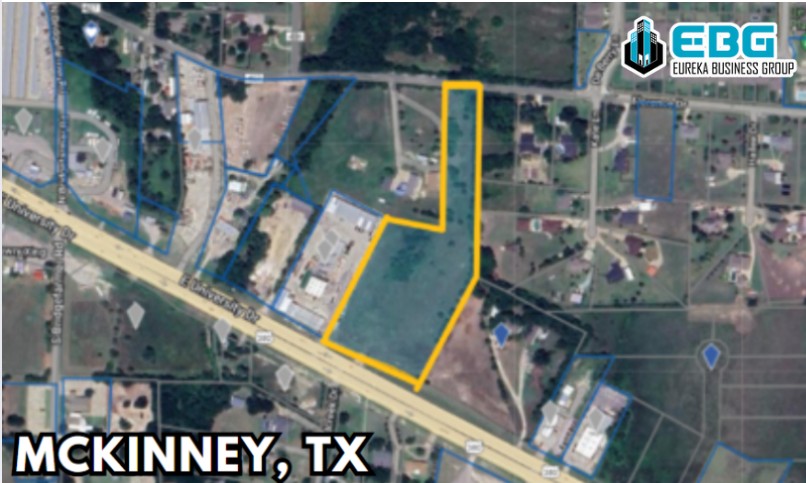
6 AC Unrestricted Land

Why we like it:

* US380 Frontage (383 ft)!
* McKinney ETJ
* On DFW’s hottest growth path!
* Exclusive EBG Listing

$5M-$10M

Eureka Business Group: Your Retail Navigator; Charting the Course for Retail Growth!

± 33,783 SF Mixed Use

Why we like it:

* Unique property Retail & Multifamily
* Across the street from UNT
* 7.25% cap rate!

Eureka Business Group: Your Retail Navigator; Charting the Course for Retail Growth!

22,620 SF Retail Center

Why we like it:

* Old ownership
* Rents below market
* Value Add Opportunity
* Frontage on US-380 with 46,000+ VPD

Eureka Business Group: Your Retail Navigator; Charting the Course for Retail Growth!

10,000 SF Child Care Center

Why we like it:

* 2023 build
* Cap rate: 7.35%
* NNN lease

Eureka Business Group: Your Retail Navigator; Charting the Course for Retail Growth!

8,062 SF Single Tenant Retail

Why we like it:

* New 10-year NNN lease
* National Credit Tenant
* Annual increases
* Prime Lower Greenville Location

Cedar Hill ISD Assets Sale

If you missed the last round, here is an opportunity to snag a few more development lots

Eureka Business Group: Your Retail Navigator; Charting the Course for Retail Growth!

CRE News 08/29/2025

Listen to this week’s hottest Commercial Real Estate News on our podcast

Listen Now

Featured Video

Eureka Business Group: Your Retail Navigator; Charting the Course for Retail Growth!

Click Here to Download The Full “7 Myths About Commercial Real Estate” Report

Eureka Business Group: Your Retail Navigator; Charting the Course for Retail Growth!

Joseph Gozlan, Managing Principal

Eureka Business Group

joseph@ebgtexas.com

(903) 600-0616

About Us

Eureka Business Group: Your Retail Navigator; Charting the Course for Retail Growth!

Established in 2008, Eureka Business Group is a full-service commercial real estate brokerage. We specialize in guiding retail investors, retail leaders, franchisees, and business owners through the complexities of retail commercial real estate in the Dallas-Fort Worth market. Whether you’re a seasoned investor, a franchisee ready to expand, or a first-time tenant, we provide expert solutions tailored to your unique goals.

Read More…

Eureka Business Group: Your Retail Navigator in DFW Commercial Real Estate

Sign Up Here

Be the first to learn about lucrative commercial real estate investment opportunities in the DFW market pre-vetted by our CRE experts!

Eureka Business Group​ | DFW Retail Investment and Capital Markets Advisors
Read More

Commercial Real Estate News – Week of August 29, 2025

Commercial Real Estate News – Week of August 29, 2025

Click below to listen: 

Transcript:

 Welcome to the Deep Dive in a world Just a Wash with information. Our mission is simple. Cut through the noise, stack up the sources, and pull out the most important insights for you. Today we’re taking a deep dive into the commercial real estate landscape, looking at news from August 21st to the 29th, 2025.

We’ll be digging into some surprising developments in retail, key economic signs, and really focusing on the incredible momentum right here in Texas, especially in the Dallas-Fort Worth market. Okay, let’s unpack this a bit. Our goal give you a shortcut to being genuinely well informed, especially if you’re, navigating the DFW retail scene.

We’re gonna explore whether those rumors about retail dying off were maybe greatly exaggerated, and what that really means for investment and growth right here in our backyard. So many people had pretty much written off malls predicting the slow, inevitable decline, but now we’re seeing some genuinely surprising headlines.

Talk about a mall resurgence, what’s really standing out? What’s fascinating here isn’t just like a simple recovery, it’s much more about strategic repositioning. Take Dillard’s for instance, they, along with Trademark Property Co. They’re based in Fort Worth, recently bought the Longview Mall in East Texas.

It’s about 646,000 square feet and they pay $34 million. Okay. And their reason their explicit reason, the one they stated was to keep it out of the hands of what they call bad actors. Groups like Kohan Retail Investment Group, Namdar Realty Group. People often accuse them of letting properties just.

You know deteriorate. So this move by Dillard’s is actually really telling, it highlights their unique financial spot. They own most of their 272 locations, and they’re apparently sitting on over a billion dollars in cash. Wow. That’s a big difference from others. Exactly. It’s a stark contrast to say, JCPenney or Macy’s who’ve been selling off properties.

Dillard’s and trademark. They plan significant investments to modernize this mall that’s 47 years old, right? And crucially, it’s the only enclosed mall within a 45 mile radius. So this isn’t just about saving one asset. It feels like a strategic counter move against those purely financial real estate groups.

It suggests maybe legacy retailers are taking more control, redefining how these properties are managed. And if we connect this to the bigger picture, look at CBL properties, another major player. They also made a pretty significant move buying four enclosed malls for about $179 million. And that’s notable because it marks their first major purchase since way back in 2015.

So it signals this renewed confidence in, let’s say, mid-tier malls of. Market segment that seems to be finding its footing again, especially when someone’s actively managing and investing in them. Okay, so we’re seeing these big strategic buys, breathing new life into malls, but is this just a few stories or is there solid data backing this up?

Especially you know, from the consumer side? Yeah, exactly, and the data absolutely supports it. It’s actually quite surprising. Altus group research. Their data shows indoor malls are actually outperforming open air shopping centers in foot traffic growth. That’s for the first half of 2025. Really? How much growth?

Nearly 2% year over year growth. And here’s where it gets really interesting. Gen Z shoppers are surprisingly a key part of this rebound Gen Z, but aren’t they supposed to be all online? That’s the common thought, right? But for a generation, often seen as tied to screens. Malls seem to be reemerging as important social hubs, experiential destinations.

It really proves physical retail is far from dead. Yeah. It’s just evolving. It’s not just about the transaction anymore. They’re looking for community shared experiences, and well-maintained. Malls are starting to provide that. Again, that is a fascinating twist. It completely flips the script we’ve been hearing for so long.

All right. Let’s shift focus directly to Dallas-Fort Worth. Now we’re seeing equally strong, maybe even stronger activity right here. What specific local developments are catching your eye? Okay. This is where it gets super relevant for anyone listening in DFW or watching this market, Disney Investment Group.

No relation to the theme park. They recently brokered the sale of Mockingbird Central Plaza. It’s an urban fill shopping center, almost 80,000 square feet right there on Mockingbird Lane, near SMU in Dallas. Urban infill. So built into an existing dense area. Exactly. Strategically placed for convenience visibility.

Yeah. And what’s really remarkable, it’s currently 98% leased, 22 tenants. 98% leased. Yeah. So this isn’t just another sale. It reflects really robust. Consistent demand for high quality, located retail here, especially in areas with strong demographics, lots of foot traffic. And this also brings up a really important point about long-term confidence strategic structuring among the big local players.

We just saw two of Dallas’s most prominent real estate. Families, Ray Washburn’s family, and the descendants of HL Hunt, the oil tycoon, combine their huge property holdings. Oh, okay. Into what? A new venture called Gillen Property Group or GPG. This portfolio, they’ve consolidated its massive, 81 properties, 10 states, 14 million square feet total.

And notably, it includes Dallas’s, historic Highland Park Village, one of the country’s first luxury shopping centers and the Knox Street Retail district too. Quite a portfolio. It really is, and this isn’t just a simple merger, it’s strategic. It simplifies management operations, and it positions them perfectly for future acquisitions, future developments.

It just shows this deep, long-term confidence in strategic retail mixed use assets, especially within Dallas, from families who really know this market. Okay, so with all this activity, the mall buys the high leasing rates, these big local consolidations. What does this tell us about retail overall?

Because many people still think physical stores are struggling against e-commerce. The data, it tells a very different and frankly, quite compelling story. Take the N-C-R-E-I property index, it’s a key benchmark for institutional real estate. It just posted its fourth straight quarter of positive returns in Q2 2025.

And guess what? Retail led all property types, retail led by how much the 1.94% return. And that’s not just a blip, it’s consistent performance now. And Brandon Isner, he is Nu Mark’s head of US retail research. He goes even further. He states pretty emphatically that and mortar is thriving, not dying, thriving.

How this research shows us retail sales per square foot have jumped, get this roughly 45% since 2019. 45%. That’s huge. It is. And at the same time, retail space per capita has actually gone down. Now that’s a critical insight. It means. Existing stores are way more productive, generating significantly more revenue from the space they have.

Ah, okay. So that efficiency supports higher rents. Exactly. And it encourages retailers to try innovative store formats, adapt to what consumers want now, experience, convenience, all of that. Beyond just the performance data, we’re seeing big brands continuing to invest and expand their physical presence.

This isn’t only about managing old properties better. Absolutely. The commitment to physical retail is pretty clear across the board. Look at Whole Foods market. They apparently have over a hundred new stores in their development pipeline for the end of 2025. They’re speeding up growth. They’re even trying out smaller formats like these 8,500 square foot daily shop concepts in dense places like Manhattan, for grab and go.

Interesting adaptation, right? And then you have Aldi, the discount grocer. They’re making an aggressive push. Their first store in Midtown Manhattan is set for 2026. That’s just part of a massive plan. Yeah, open over 225 new stores this year. Invest $9 billion to add 800 stores by 2028. $9 billion, 9 billion.

These aren’t small adjustments. These are major strategic multi-billion dollar bets on expanding their physical footprint, adapting to different consumer needs. And even look at the capital markets, there’s significant confidence flowing back into retail there too. Bridge 33 Capital, for example, just secured a $460 million CMBS loan.

Okay, remind us. CMBS is commercial mortgage-backed securities. Basically, it’s. Cooled investment in property debt. They used it to refinance a portfolio of 12 retail properties across nine states. That portfolio was 91.4% leased, solidly leased then very. And the fact that the CMBS market is confidently backing such a large well leased retail portfolio that signals strong return of appetite from institutional lenders for these kinds of assets, they seem to be moving past earlier worries.

It suggests a healthy market for retail that’s performing well. It really seems the national retail story is. A lot more complex and frankly more optimistic than many realize. Okay. Let’s pivot now to the incredible energy we’re seeing specifically in North Texas commercial real estate. What are the big headlines?

Making our regions such a magnet for investment. Really setting it apart. Yeah. This is where the regional focus just highlights this powerhouse economy. We have, WalletHub did a study best real estate markets, and they identified five of the nation’s top 10 markets. Right here in North Texas, five out of the top ten five with McKinney taking the number one spot nationally.

Frisco, Richardson, Denton, Alan Drawn. They also showed really strong new construction activity. McKinney actually had the second highest share of houses built between 2010 and 2023, roughly 38% of its housing stock. That’s incredible growth. It’s not just growth, it indicates this phenomenal population influx, really robust economic foundations, and it sustained demands.

It’s just rare nationally. It tells you people really wanna live and work here. And maybe no single project shows this economic pull better than the new Goldman Sachs campus in uptown Dallas. The $500 million one, that’s the one construction’s well underway on that three acre site. Completions expected by 2028, we’re talking 800,000 square feet capacity for over 5,000 employees.

5,000, yeah. And this isn’t just another office building. It’s like a statement. It cements Dallas as a critical global hub for Goldman. And it really exemplifies that broader trend, the financial industry migrating to Sunbelt cities. Why the Sunbelt? Lower operating costs. Yeah. Business friendly environment.

Growing talent. Pool companies like Bank of America, JP Morgan, Schwab, they’re all expanding here too. And that in turn, fuels demand for all kinds of commercial property, including retail, to serve all those employees. And it’s not just finance, right? North Texas is rapidly becoming a major tech hub too.

That term Silicon Prairie seems less like hype now. Absolutely. It’s not just a buzzword anymore, it’s reality. We’re seeing over 50 billion. Billion with AB in semiconductor and tech projects actively transforming North Texas. Sherman, Texas is really the epicenter right now. You’ve got Texas Instruments, nearly $30 billion chip pab.

You’ve got multi-billion dollar facilities from global wafers and Coherent. And Apple recently announced something too. That’s right. Apple announced that a hundred billion dollars US manufacturing push. A lot of that is apparently earmarked for production based in Sherman. This isn’t just about high tech jobs though.

This tech boom is triggering a massive surge in housing demand and critically demand for all types of commercial property across the whole region, office, industrial. And yes, the retail needed to support this huge influx of workers and their families. And you can add another layer to that tech story, Hillwoods Alliance, Texas over in Fort Worth.

They just landed a huge $760 million AI deal with Wistron, the electronics giant from Taiwan, an AI deal. What does that involve? It involves establishing two massive AI supercomputer plants. Totaling 1.1 million square feet could create over 800 new jobs. And Fort Worth wasn’t just picked randomly. They cited the skilled talent pool, the strong logistics infrastructure, that vibrant industrial ecosystem in Alliance Texas.

Okay. It just reinforces North Texas emerging as this national hub for advanced manufacturing logistics and really critical AI infrastructure. It diversifies our economic base even more. So even while we hear national talk about rising office vacancies, maybe a slowdown DFW seems to be really bucking those trends quite significantly.

That’s absolutely right. Despite those national office vacancy rates climbing, the Dallas-Fort Worth office market is holding remarkably steady. In fact, DFW ranked second nationwide for total office construction right alongside a strong market like Boston second in the nation for construction. That’s surprising given the headlines.

It is. And this broad strength just underscores that developers here in North Texas, they remain confident in specific, chosen new projects. Why? Because they’re driven by our exceptional local economic growth, population growth, especially for that class A space that modern tenants demand. It’s really a testament to the region’s power to attract and keep major companies.

And if we connect this to the bigger picture. Remember all that fear just a year or two ago about a commercial real estate doomsday for banks, especially around distressed properties. Yeah. Yeah. That was everywhere. That now looks largely unlikely. Those concerns have mostly quieted down Banks showed they could work through problem properties, case by case, avoiding some kind of systemic crisis, and you see that stability reflected in the market data transaction volumes were up a healthy 13% year over year in the first half of 2025.

Okay. That’s positive and US commercial property prices. They posted back to back year over year gains in June and July. That’s the first time since mid 2022. It reflects clear stabilization, maybe even slight rises in valuations. Even sales in that crucial middle market properties between 5,000,020 $5 million, they saw a 3.5% game in the first half.

So renewed activity across different investment levels. Beyond these really dynamic local markets and the stabilizing national picture, there are also potentially huge shifts happening in the broader capital markets, right? Things that could fundamentally redefine how commercial real estate gets funded.

And this raises a really important. Potentially game changing question. Where’s the next big wave of capital for commercial real estate gonna come from? President Trump recently sparked a lot of industry buzz with an executive order. It aims to potentially unlock some of that staggering. $12 trillion held in 401k assets, 12 trillion for things like real estate, for alternative investments.

Yeah, including real. And right away the labor secretary rescinded an older Biden era statement that had discouraged 401k plans from looking at alternatives. So now regulators have 180 days to review the fiduciary guidelines, but there are hurdles aren’t there with retirement funds and illiquid assets?

Oh, absolutely. There are legitimate hurdles. Erisa, that’s the Employee Retirement Income Security Act, has really strict duties to protect retirement savings. Direct real estate investment is tricky because it’s a liquid, hard to value daily like stocks, but. The sheer scale of this potential capital shift has the industry just waiting with quote, bated breath, dedicated, defined contribution real estate funds, they already hold about $36.4 billion, and major financial firms are actively getting ready for this potential flood of new money, so it could be significant.

It suggests a really significant new path for capital if the rules evolve to make it more practical and accessible. Ah, it could honestly be a tidal wave of fresh investment. Okay, so let’s bring all these threads together. We’ve talked national retail resilience, the DFW boom, potential new capital sources.

What does this ultimately mean for you, our listener, whether you’re an investor, a business owner, or just tracking the North Texas market? Ultimately, I think the picture is one of really immense and varied opportunity. You’ve got this convergence. Stabilizing national property prices. This unexpected powerful resilience in retail, driven by smart adaptation and new consumer habits.

And then you layer on the explosive diversified growth right here in North Texas from becoming a critical financial hub. Transforming into Silicon Prairie, it paints a remarkably robust, optimistic outlook. And for those focused specifically on Dallas-Fort Worth retail, the strong local demand, the strategic investments by major players like Gil and Property Group, the constant influx of a growing diverse workforce, the whole economic boom, it creates an exceptionally fertile.

This market isn’t just poised for continued evolution. It’s an active landscape for significant value creation, especially for those who really understand the local dynamics and know how to position themselves strategically. Wow, what a deep dive. Indeed. We’ve certainly uncovered a really compelling story today, retail resilience, smart investment, north Texas, just emerging as this undeniable economic powerhouse.

The data really confirms. It’s a dynamic, evolving landscape. It’s far from those doom and gleam predictions We sometimes still hear. Indeed. Yeah. The DFW market, especially in retail, isn’t just, surviving. It’s thriving, it’s diversifying, actively adapting, and that’s driven by forward thinking, local leadership, massive diverse investment, and just this.

Ever expanding population base. So let’s leave you with this provocative thought. As major players from department stores detect giants, strategically invest and adapt to the shifting consumer and economic landscapes, and with potentially trillions in new capital, maybe coming from sources like 401k. How will these profound shifts redefine your understanding of commercial real estate’s future?

Where do you see the next wave of innovation landing? And maybe more importantly, how will you position yourself to capture that opportunity in dynamic markets like Dallas-Fort Worth, something definitely worth mulling over until our next deep dive.

** News Sources: CoStar Group 
Read More

EBG Listings of The Week 08-23-2025

EBG Listings of The Week

August 23, 2025


Yesterday the Fed hinted of an upcoming interest rates. The market no longer debates IF there will be a rate cut, everyone is debating if it’ll be 0.25% or 0.50% cut!
With that said, if the cut really happens and it ends up being on the higher side then we expect to see two things happen at the same time:

1) Many buyers will get off the fence and start buying again

2) Sellers will want to capture some of that drop and prices will go up in some cases. 

If you are one of those investors that have been waiting for rates to drop to get back in the game, your best bet is to lock a property under contract in the next 3 weeks before the next Fed meeting on 9/17. Let us know how we can help!

If you wanted to keep up to date on retail real estate news, we have a LinkedIn Newsletter you can subscribe to.

As we do every week, we took time and reviewed all the commercial listings that came on the market and curated this hand-picked list representing the top opportunities we identified as the best value.


Did you know you can LISTEN to this email?

Under $2M

Eureka Business Group: Your Retail Navigator; Charting the Course for Retail Growth!

5 Unit Multifamily 

Why we like it:

* Prime Uptown Dallas location
* High-demand rental corridor 
* Covered parking + on-site laundry

Eureka Business Group: Your Retail Navigator; Charting the Course for Retail Growth!

12,000 SF Retail Center

Why we like it:

* 100% leased 
* Anchored by long-standing Korner Food Store & gas station
* Cap Rate: 6.69% 
* Strong demographics

Eureka Business Group: Your Retail Navigator; Charting the Course for Retail Growth!

9,000 SF Single Tenant

Why we like it:

* Corporate guarantee
* 7.25% cap rate 
* Annual rent increases 

$2M-$5M

Eureka Business Group: Your Retail Navigator; Charting the Course for Retail Growth!

6,999 SF Medical Office #1

Why we like it:

* Absolute NNN leases
* Annual rent increases
* Strong demographics

Eureka Business Group: Your Retail Navigator; Charting the Course for Retail Growth!

5,922 SF Medical/Service #2

Why we like it:

* Absolute NNN leases
* Annual rent increases
* Strong demographics

Eureka Business Group: Your Retail Navigator; Charting the Course for Retail Growth!

6 AC Unrestricted Land

Why we like it:

* US380 Frontage (383 ft)!
* McKinney ETJ
* On DFW’s hottest growth path!
* Exclusive EBG Listing

Eureka Business Group: Your Retail Navigator; Charting the Course for Retail Growth!

12,000 SF Flex / Industrial

Why we like it:

* 100% leased
* High visibility on I-35 frontage
* Value Add

$5M-$10M

Eureka Business Group: Your Retail Navigator; Charting the Course for Retail Growth!

50,573 SF Retail Center

Why we like it:

* Upside potential via lease renewals and rent growth
* Located in established Lewisville retail corridor
* Over 8% cap rate

Eureka Business Group: Your Retail Navigator; Charting the Course for Retail Growth!

22,620 SF Retail Center

Why we like it:

* 95.7% leased
* Prime US-380 frontage
* New roof coating in 2025 

Eureka Business Group: Your Retail Navigator; Charting the Course for Retail Growth!

9,948 SF Retail Center

Why we like it:

* Newly built in 2025 
* 100% leased
* Long WALT (8.6 yrs) with built-in rent growth
* Prime Hwy 121 corridor in high-growth Melissa 

Eureka Business Group: Your Retail Navigator; Charting the Course for Retail Growth!

4,000 SF Single Tenant

Why we like it:

* 2023 build-to-suit 
*Absolute NNN lease
* 15 years Corporate guarantee
* 7.0% cap
* Top 25% most visited restaurants in OK

$10M plus

Eureka Business Group: Your Retail Navigator; Charting the Course for Retail Growth!

17,978 SF Retail Center

Why we like it:

* Built 2024 | 100% leased
* Strong tenant mix: Action Behavior Centers, Shipley Donuts, CJJF Jiu Jitsu, Kindred Smiles, Krishna Bhavan
* Affluent McKinney submarket – $198K avg. HH income 1 mile

Eureka Business Group: Your Retail Navigator; Charting the Course for Retail Growth!

64,600 SF Flex Industrial

Why we like it:

* 6 buildings + 34 RV parking spaces
* 100% leased
* Rents below market
* Built 2018
* $141K avg HH income 1 mile

Cedar Hill ISD Assets Sale

If you missed the last round, here is an opportunity to snag a few more development lots

Eureka Business Group: Your Retail Navigator; Charting the Course for Retail Growth!

CRE News 08/22/2025

Listen to this week’s hottest Commercial Real Estate News on our podcast

Listen Now

Featured Video

Eureka Business Group: Your Retail Navigator; Charting the Course for Retail Growth!

Click Here to Download The Full “7 Myths About Commercial Real Estate” Report

Eureka Business Group: Your Retail Navigator; Charting the Course for Retail Growth!

Joseph Gozlan, Managing Principal

Eureka Business Group

joseph@ebgtexas.com

(903) 600-0616

About Us

Eureka Business Group: Your Retail Navigator; Charting the Course for Retail Growth!

Established in 2008, Eureka Business Group is a full-service commercial real estate brokerage. We specialize in guiding retail investors, retail leaders, franchisees, and business owners through the complexities of retail commercial real estate in the Dallas-Fort Worth market. Whether you’re a seasoned investor, a franchisee ready to expand, or a first-time tenant, we provide expert solutions tailored to your unique goals.

Read More…

Eureka Business Group: Your Retail Navigator in DFW Commercial Real Estate

Sign Up Here

Be the first to learn about lucrative commercial real estate investment opportunities in the DFW market pre-vetted by our CRE experts!

Eureka Business Group​ | DFW Retail Investment and Capital Markets Advisors
Read More

Commercial Real Estate News – Week of August 22, 2025

Commercial Real Estate News – Week of August 22, 2025

Click below to listen: 

Transcript:

 Welcome to the Deep Dive. Scrolling through commercial real estate headlines lately, it really feels a bit like whiplash. It doesn’t it? Yeah. One minute. Economic uncertainty the next, it’s all this robust market activity. Exactly. It’s a fascinating, sometimes, contradictory picture.

Definitely. So our mission today is to try and cut through some of that noise. We’re taking a deep dive into the most important nuggets, the key insights from recent commercial real estate news, specifically looking at roughly August 14th through the 22nd, 2025. And we’ll focus quite a bit on the, surprisingly resilient retail sector and also the absolutely booming Dallas-Fort Worth market.

Two really key areas right now. Our goal is just to give you a clear, concise understanding of what’s happening, why it matters for you, and maybe what to watch for as we navigate these complex market dynamics. That’s good. Let’s dig in. So the sources we’ve looked at, they really reveal a nuanced picture.

It’s far from simple doom and gloom or, unbridled optimism. Especially in retail. Yeah. We’re seeing significant shifts both in how consumers are behaving and where investment money is going, and that’s creating this unique landscape. Challenges, opportunities, understanding those underlying drivers is, I think, crucial to really grasp what’s going on.

Absolutely, and when we look at the national retail trends, the consumer is definitely at the heart of it all always is the latest retail sales data for July, 2025. It tells an interesting story. So top line retail sales, Roche 4.3% year over year. Core retail was up 4.7%, which on the surface sounds pretty promising, right?

It does. But the real insight, and this is critical for you to understand, is that beneath that surface, the actual volume growth was pretty sluggish. Just 1.4%. Okay. So people are spending more money, but not necessarily. Buying much more stuff. Inflation’s playing a role there. Exactly. And analysis suggests a significant chunk of that.

Spending maybe $6.2 billion was what they call pull forward activity. What do you mean? Meaning money spent now maybe driven by big promotions like Amazon Prime Day or back to school sales. Or maybe even a little anxiety about future prices getting things bought before they go up more could be, but it signals, it’s not necessarily consistent, confident consumer demand driving it.

It’s more event driven. It hints at some market fragility in What’s truly striking, I think, is this idea that consumers are quote. Bargain hunting and bracing for future shocks. We saw that play on the numbers. Robust sales games and categories like home furniture, up 5.8% and apparel, which climbed 7.4%. It really does this whole selective spending pattern.

It seems like a critical sign of a a broader economic shift. It connects directly to something Meredith Whitney, often called the Oracle of Wall Street. She recently warned about a brewing bifurcated economy. Bifurcated meaning split exactly. She cautions that wealthier households are continuing to spend quite strongly while lower income consumers are facing.

Really mounting pressure. Okay. And her prediction is almost counterintuitive. She thinks discount chains and dollar stores, the ones we usually see as defensive and downturns, could be among the hardest hit this time. That is interesting. Why Usually they benefit when people trade down, because their specific customer base, the economically challenged group, is under even greater strain now.

Their budgets are just stretched incredibly thin. That’s a fascinating point. So what kind of early signs or mechanisms does she point to that make that group more vulnerable now compared to past downturns? Stepping back, the broader data does seem to support this widening divide. She’s talking about high earners, let’s say those making over $250,000 a.

They now account for about 50% of all US consumer spending 50%. Wow. What was it before? It was around 36%. Three decades ago. That’s a significant shift. Huge shift. And for retail landlords, this isn’t just some abstract trend, it’s becoming a strategic imperative. Meaning they need to adapt their properties.

Exactly. They’re being advised to really curate their tenant mixes carefully to make sure they serve a broad income spectrum. It’s a hedge against what some are calling an hourglass spending pattern hourglass, like strong at the top and bottom, weak in the middle. Precisely. Strength at the high end, continued demand for essentials and value at the lower end, but real pressure on that mid-market segment is like the sand flows to the top and bottom bulbs.

So how is this complex consumer picture actually shaping the, the physical spaces, the stores, the shopping centers? What does it mean for the real estate itself? The physical retail market is definitely showing a split in demand for space, right? Reflecting that consumer behavior. Okay. While overall retail is showing some unexpected resilience, it’s definitely an uneven landscape.

Smaller storefronts, they seem to be thriving, but the big box spaces, they’re genuinely struggling. A tale of two markets almost. So looking at the numbers from the first half of 2025. Tenant openings actually outpaced closures by about 21 million square feet, which sounds positive. That marks 10 straight quarters of rising net demand.

It does however, and this is the big challenge, we’ve also seen over 10,000 store closures in the last 18 months. Why have 10,000. Totaling around 140 million square feet of space, mostly from bankruptcies of those large format chains like Joanne, Rite Aid, big lots, right? Those bigger footprints, and that has led to two straight quarters of negative net absorption.

More space was vacated than least about negative 14.5 million square feet, just in the first half of 2025. So openings are happening. But these big closures are leaving significant holes. Exactly. And a critical point for you to grasp is that the sheer volume of these vacant big box and junior anchor spaces, 10,000 to 50,000 square feet, sometimes more, they’re incredibly difficult to backfill.

Why is that? Just too much space partly, but they often require costly reconfigurations, splitting them up, redoing infrastructure, and many of the expanding retailers today, they just don’t want or need that kind of space or expense. Okay, that makes sense. It directly contrasts with what you said about small footprints.

Totally. Nearly 90% of all the lease deals in Q2 were for spaces under 5,000 square feet, 90% and get this, two thirds of those deals were even smaller. Below 2,500 square feet. So really small shops who’s taken those. It’s largely fast casual restaurants, quick service restaurants, QSRs, and those essential service oriented shops.

Think nail salons, small clinics, things like that, right? The kinds of businesses that need less square footage. And adding to this dynamic new retail construction is really at a crawl, just 4.9 million square feet of starts in Q2. High costs, general caution. So if you’re a growing retailer, needing space, new builds aren’t really the main option.

Increasingly, no. They’re turning more and more to second generation spaces that were previously occupied. Makes sense. Is that speeding things up? It seems so. The average downtime for a vacated store before it gets released has actually shrunk to about 7.1 months. That’s a pretty significant indicator of this demand for existing smaller spaces, almost like musical chairs, but for retail locations.

Huh. Something like that. Everyone’s become a retail ninja. Get in, get set up. Mission accomplished. So bringing this back to the investment side, despite these big closures and the negative net absorption figures we talked about, investment capital is actually still flowing into retail. Which is maybe surprising, it is a bit counterintuitive.

US retail investment volume for the first half of 2025 hit $28.5 billion. That’s up 23% year over year. 23%. That’s substantial. It is, and it actually exceeds the long-term historical average for investment volume in retail. So what are investors targeting then, if not just any retail. It seems they’re favoring mixed use retail assets, places combining retail with residential or office, and focusing on high performing metro areas.

They’re betting on long-term resilience in those specific spots. And how are these deals getting funded? Are traditional banks leading the charge? Interestingly, no. We’re seeing non-bank lenders and the commercial mortgage-backed securities market. Yeah, the CMBS market really stepping up to fill the financing gap as traditional banks seem to be pulling back a bit.

That’s a massive shift in how projects get funded, isn’t it? But what does that increasing reliance on non-bank lenders and CMBS mean for the, say, the risk profile of these retail investments down the line? Are investors just trading one set of risks for another to get yield? That’s the million dollar question, isn’t it?

Right now, the market certainly seems to think the reward outweighs the risk, or at least that the risk is manageable in these specific deals. Gun example? Yeah, a pretty concrete one. Wells Fargo recently led a $460 million single borrower CMBS deal. Okay. This was to refinance 12 retail centers across nine states.

They’re part of Bridge 33 capital’s portfolio, which is 91% leased and anchored by solid tenants like TJX, Dick’s Sporting Goods. So quality assets, strong tenants. Exactly. And the fact that this deal got done and done through the CMBS market, it clearly demonstrates there’s still significant investor appetite for securitized retail debt provided the underlying assets are perceived as strong.

Okay. Now if we turn our attention specifically to Texas, wow. What immediately jumps out is just how much of a powerhouse the Dallas-Fort Worth market has become. Oh, absolutely. DFW really stands out nationally. It’s the most active US market for new retail space. We’re talking nearly 7.15 million square feet under construction right now.

7 million square feet. That’s huge. It’s a whopping 15% of all the retail space currently under construction, across the 60 plus US markets that are tracked 15% in one metroplex. That’s incredible. And it’s not just DFW. Austin’s got about 3.4 million square feet underway. Houston around 3.9 million. They’re also wanking high.

So it’s a Texas wide phenomenon. Really. Yeah. Driven by that incredible population growth, presumably. Absolutely. And this level of activity, this growth, it’s exactly why we at Eureka Business Group specialize in the DFW market. It’s undeniably where the action is for retail. Makes sense to focus there.

What are some specific examples driving that DFW number? Look at Grand Prairie. Their city council just annexed about 900 acres for a project called Goodland. Yeah, it’s part of a massive 5,000 acre master plan community being developed by Providence Realty Advisors, 5,000 acres. That’s practically a small city.

It really is. They’re envisioning thousands of homes. Multiple retail centers, parks, civic facilities, even a 50 acre pound center. Wow. What’s a potential scale? They estimate it could eventually house 50,000 residents and generate something like $5 billion in taxable value for the city. Incredible. And the officials see this as a way to attract new retail.

Exactly. Bringing desired amenities and retailers directly to where the new population growth is happening. It’s a huge bet on continued expansion in that part of the metroplex. And it’s not just new builds, right? Or existing players expanding to, definitely. Another intriguing piece is HEB. They’re investing in a big new warehouse in Fort Worth, 139,000 square feet.

Okay, but that’s a warehouse, not a store. It’s not for shoppers. It’s purely to support their really aggressive North Texas expansion strategy. It highlights the logistics side needed to serve all these new stores and people. Driven by that population growth again, how many new residents are we talking?

The region gained over 560,000 residents, just between 2020 and the start of 2024. That’s fueling everything that explains the need for logistics support. Any other types of projects. Yeah. We’re also seeing interesting adaptive reuse. There’s a historic downtown Dallas hotel that’s slated for conversion into a mixed use residential project.

Ah, turning old buildings into new uses, right? It reflects that broader push for more downtown living, which in turn has the potential to spur more ancillary retail restaurants, nightlife, as more people actually live in the city’s cor again. So looking wider, what are the broader factors drawing all this investment and development specifically to Texas beyond just population growth?

Several things seem to be converging. For instance, the new federal Opportunity Zone 2.0 program seems to be disproportionately benefiting Texas markets funneling tax advantage investment into these areas. Exactly into commercial projects, including retail development. That’s certainly helping. And we see strength in other Texas metros too.

You mentioned Houston earlier. Yeah. Houston provides another compelling example. Hez just paid about $137.6 million for a project called the Montrose Collective. Montrose collected it, set a new local price per square foot record around $727. It’s a mixed use complex. Includes about 50,000 square feet of high-end retail and restaurant space.

So big money betting on top tier, urban mixed use, even at record prices, shows confidence. Definitely. And even in the Austin Metro, look at Cedar Park, there’s a development called Cedar View. Cedar View. What’s going in there? It’s going to host Texas’s second largest retail store and NFM Nebraska Furniture Mart at 1.3 million square feet, 1.3 million.

Just for one store. Yeah. And also a huge Shields Sporting Goods store, about 357,000 square feet. It’s designed to be a massive regional draw. So these aren’t just neighborhood centers, these are destination projects. Banking on attracting people from miles around. Absolutely, and they’re all underpinned by those strong demographics and what’s generally seen as a pro-growth environment in the state.

It’s clear the growth here is substantial, almost staggering in places like DFW, how sustainable is this pace? Are there any potential speed bumps or I guess long-term challenges for markets like DFW, if that population grows were to slow, or if the bigger economic tides were to shift more dramatically?

That’s the critical question, isn’t it? Especially as we turn now to some of the economic headwinds that are still out there impacting commercial real estate development and maybe consumer confidence too, like what’s specifically for instance, the new Trump administration tariffs that have been announced, like a potential 35% tariff on Canadian goods, that’s expected to significantly increase construction costs, right?

Materials costs going up. Do we have any sense of the scale of impact? We can get an idea. The National Association of Home Builders, the NAHB. They previously noted that tariffs already in place by March, 2025 had added something like $9,200 to the cost of an average new home. Okay, that’s already significant.

And now with these latest potential hikes, some experts estimate builder costs could rise by another 7,500 to $10,000 per home. Wow, that’s a substantial hit, direct impact for developers. And ultimately it gets passed on to consumers, right? Usually does. And then there’s the Federal Reserve. They seem caught between a rock and a hard place.

Still worried about inflation versus the labor market. Exactly. Ongoing worries about both. Most Fed officials seem to agree. It’s just too soon to think about cutting interest rates, even though the latest inflation number July’s consumer prices rows may be a bit less than expected, about 2.7% annually.

Even with that slightly softer number, the consensus seems to be hold steady for now. So the takeaway for you don’t hold your breath waiting for keeper borrowing costs in commercial real estate anytime soon. Rates look set to stay elevated. It’s certainly interesting then to watch how investors are trying to, as you said earlier, separate the signal from the noise in this really mixed environment.

Yeah. Interest rates are likely to stay up. The federal funds rate is projected around 3.9% by late 2025 and the 10 year treasury yield. It keeps defying expectations, right? It rose from about 3.6% to 4.6% higher for longer. Seems to be the reality seems to be. And yet, despite those figures that investment resilience, we talked about persists.

Investors spent 25% more on US commercial real estate in the first half of 2025 compared to the same period in 20 24, 20 5% more even with higher rates. And Q2 deal volumes specifically climbed 18% year over year. CBRE for example, they’re still maintaining a projection for 10% annual growth in overall investment volume for the year.

Yeah. And they see cap rate showing stability. So on one hand you’ve got this impressive investment resilience, big money flowing in, especially to quality assets and growth markets. But on the other hand, you have things like small businesses feeling maybe a bit less optimistic, right? The small business optimism index did dip slightly down to 98.6 in June.

Consumer credit trends showing some caution. Yeah. Overall consumer credit growth persisted, but revolving credit. Think credit cards. It actually fell in the latest numbers for the first time since November 20, 24. Suggest people might be getting wary about taking on more high interest debt, maybe pulling back on discretionary spending.

Exactly. So how do those two conflicting signals the investment surge versus the underlying consumer caution? How do they really influence where capital is flowing, especially into retail real estate right now? It feels like a very delicate balance. The market is navigating that investment seems laser focused on perceived quality and growth, while the broader consumer base is well being careful, which means the future health of retail.

Particularly for those mid-market or maybe even the discount segments Meredith Whitney warned about really depends heavily on that consumer sentiment holding up or improving. So to quickly summarize what we’ve really dug into today, first, retail is showing some maybe unexpected resilience. It’s adapting to these value conscious consumers and their shifting preferences for smaller, more service oriented spaces.

Even while those big box properties face some real challenges with. Backfilling vacant space, second, we’ve highlighted that Texas and particularly the Dallas-Fort Worth market really stands out as a national leader in retail construction, and it’s a huge magnet for investment right now, driven by that potent combination of robust population growth.

And strategic, often large scale development projects. And finally, despite those ongoing economic headwinds, things like new tariffs, potentially rising costs, interest rates staying elevated, there’s still a strong flow of capital, actively targeting high quality assets and these specific high growth markets.

So the message for you. Listening seems clear, understanding the specifics, the nuances, targeted knowledge, that’s really your best asset in this dynamic environment. Said. And this all raises, I think an important question for the future. Something for you to maybe mull over. Okay. How will this.

Increasing emphasis on flight to quality in retail combined with that ongoing challenge of redeveloping and backfilling these large vacant spaces. How will that ultimately reshape the tenant mix and the investment strategies in dynamic growing markets like Dallas Fort Worth in the coming years?

Will we see maybe an acceleration of adaptive reuse or perhaps entirely new models emerge to fill those voids? That is a compelling question to think about. What does fill that space and how does it change the landscape? Excellent point. Thank you for joining us for this deep dive into the latest in commercial real estate.

We hope you feel better informed and maybe a bit more ready to navigate these evolving market dynamics. We’ll catch you next time.

** News Sources: CoStar Group 
Read More

EBG Listings of The Week 08-16-2025

EBG Listings of The Week

August 16, 2025


We see strong moves happening in the retail real estate side of things. While increasing rents are causing some hesitation among investors, we see a slowdown in new retail construction due to the high costs of building these days which balances out the increases in rents.
A few recent headlines that support the strength of retail real estate these days:
++ Retail real estate investment hit $28.5B in the first half of 2025.
++ Simon Property Group, the biggest mall owner in America, just raised $1.5B
++ Amazon announced plans to expand same-day grocery delivery to 2,300 cities by the end of 2025

So overall, we are very bullish on retail real estate with a cautious eye for over-inflated rents that would pose risk in the future.

If you wanted to keep up to date on retail real estate news, we have a LinkedIn Newsletter you can subscribe to.

As we do every week, we took time and reviewed all the commercial listings that came on the market and curated this hand-picked list representing the top opportunities we identified as the best value.


Did you know you can LISTEN to this email?

Under $2M

Eureka Business Group: Your Retail Navigator; Charting the Course for Retail Growth!

2,354 SF Carwash

Why we like it:

* Bitesize deal ($350K)
* Located near I-35E & Belt Line * Dense Carrollton submarket with ~186K residents in 3-mi radius
* Redevelopment Opportunity

Eureka Business Group: Your Retail Navigator; Charting the Course for Retail Growth!

 2,850 SF Retail Dual Tenant

Why we like it:

* 100% leased.
* Heritage District
* 7.25% cap rate

Eureka Business Group: Your Retail Navigator; Charting the Course for Retail Growth!

 2,750 SF Retail / Office 

Why we like it:

* Rare Prosper 1AC lot

* Redevelopment Opportunity

* Across from new apartments complex

$2M-$5M

Eureka Business Group: Your Retail Navigator; Charting the Course for Retail Growth!

14,751 SF Nursing Home

Why we like it:

* Brand-new 15-yr NNN lease
* 8.5% cap
* Zero landlord responsibilities
* Bonus Depreciation Special

Eureka Business Group: Your Retail Navigator; Charting the Course for Retail Growth!

6,034 SF Retail Center

Why we like it:

* Hard-corner at US-75 & Parker (133K VPD)
* 267K residents within 5 miles
* $113K avg HH income (5 mi)

Eureka Business Group: Your Retail Navigator; Charting the Course for Retail Growth!

6 AC Unrestricted Land

Why we like it:

* US380 Frontage (383 ft)!
* McKinney ETJ
* On DFW’s hottest growth path!
* Exclusive EBG Listing

Eureka Business Group: Your Retail Navigator; Charting the Course for Retail Growth!

11,896 SF Government Tenant

Why we like it:

* Texas Parks & Wildlife Dept.
* Long-term single-tenant lease
* Reliable credit-backed income stream | 7.41% cap rate

Eureka Business Group: Your Retail Navigator; Charting the Course for Retail Growth!

6,762 SF Industrial 

Why we like it:

* Frito-Lay distribution facility
* Corporate guarantee
* Strategic Fort Stockton location near I-10
* Annual Increases

Eureka Business Group: Your Retail Navigator; Charting the Course for Retail Growth!

22,400 SF Industrial Park

Why we like it:

* 100% leased (cannabis cultivation tenants)
* 11.5% cap rate
* 2020 Construction

$5M-$10M

Eureka Business Group: Your Retail Navigator; Charting the Course for Retail Growth!

10,000 SF Child Care

Why we like it:

* National childcare brand. 
* 15-year NNN lease (zero landlord obligations)
* 7.35% cap rate

Eureka Business Group: Your Retail Navigator; Charting the Course for Retail Growth!

35,650 SF Retail Single Tenant

Why we like it:

* Corporate 24 Hour Fitness lease
* Limited landlord obligations
* 9.0% cap rate
* Affluent Southlake trade area 

$10M plus

Eureka Business Group: Your Retail Navigator; Charting the Course for Retail Growth!

37,000 SF Retail Single Tenant

Why we like it:

* LA Fitness corporate lease
* Dense & affluent trade area
* Prime McKinney retail corridor w/ 96K VPD

Eureka Business Group: Your Retail Navigator; Charting the Course for Retail Growth!

CRE News 08/15/2025

Listen to this week’s hottest Commercial Real Estate News on our podcast

Listen Now

Featured Video

Eureka Business Group: Your Retail Navigator; Charting the Course for Retail Growth!

Click Here to Download The Full “7 Myths About Commercial Real Estate” Report

Eureka Business Group: Your Retail Navigator; Charting the Course for Retail Growth!

Joseph Gozlan, Managing Principal

Eureka Business Group

joseph@ebgtexas.com

(903) 600-0616

Recent Closings

Eureka Business Group: Your Retail Navigator; Charting the Course for Retail Growth!

Looking to sell your property?

About Us

Eureka Business Group: Your Retail Navigator; Charting the Course for Retail Growth!

Established in 2008, Eureka Business Group is a full-service commercial real estate brokerage. We specialize in guiding retail investors, retail leaders, franchisees, and business owners through the complexities of retail commercial real estate in the Dallas-Fort Worth market. Whether you’re a seasoned investor, a franchisee ready to expand, or a first-time tenant, we provide expert solutions tailored to your unique goals.

Read More…

Eureka Business Group: Your Retail Navigator in DFW Commercial Real Estate

Sign Up Here

Be the first to learn about lucrative commercial real estate investment opportunities in the DFW market pre-vetted by our CRE experts!

Eureka Business Group​ | DFW Retail Investment and Capital Markets Advisors
Read More

Commercial Real Estate News – Week of August 15, 2025

Commercial Real Estate News – Week of August 15, 2025

Click below to listen: 

Transcript:

 Welcome to the Deep Dive, your essential shortcut to staying well-informed on the pulse of commercial real estate. Today, we’re cutting through the noise, distilling the most impactful developments from the last eight days. That’s August 8th through 15th, 2025. Our mission is really to highlight what’s truly significant, especially for those of you in navigating the well, the dynamic Dallas-Fort Worth market, and more broadly, the evolving retail sector as your guides from Eureka Business Group.

We’re here to help you unpack these critical shifts indeed and the overarching narrative from this past week. It really points to a clear accelerating recovery momentum across commercial real estate. We’re seeing major industry players, not just cautiously optimistic. But actually raising their outlooks.

We’ll be connecting these compelling national trends directly to what’s happening on the ground here, especially in key markets like DFW. Okay. Let’s dive right into this broad CRE recovery then, because our sources, they paint a pretty clear picture of strengthening markets. What truly stands out immediately as we look at the the big picture?

What’s particularly compelling, I think, is that. For the first time since since 2020, all five major CRE services companies, C-B-R-E-J-L-L, Cushman and Wakefield, Colliers and Newmark, they all increase their financial outlooks in the same quarter simultaneously. That’s not just a ripple of optimism, it’s it’s more like a wave.

Yeah. Suggest a really profound and widespread shift in market sentiment. It definitely points to a more robust recovery than maybe many might have anticipated even just a few months ago. That’s a powerful observation. Yeah. So with all five of these major firms raising their outlooks, it feels like the big money, those institutional investors, they must finally be shaking off that wait and see approach we’ve talked about for so long.

Are they finally jumping back in? You’ve hit on something essential there. They absolutely are. This recovery. Even despite elevated interest rates, it’s largely fueled by institutional investors finally unleashing their dry powder. That’s a record. $350 billion in capital, specifically earmarked for real estate investments that had just been waiting on the sidelines.

Blackstone, for instance, leads the pack. An astounding $177 billion in global capital ready to go. So this influx has ignited some pretty intense competition for quality deals. It’s creating what Joseph Bazzi over at Newmark, he’s head of commercial capital markets research there. He calls it a. Sellers market for prime assets, Uhhuh, equity funds wanna deploy, but they need the right deals.

Makes sense. And drilling down on market stability. There’s a fascinating update from Brookfield Property Partners that tells us a lot about the broader health of these big portfolios, doesn’t it? They reported a dramatically smaller net loss in Q2 2025, down to $46 million from what, $789 million a year earlier.

That’s quite a turnaround. That’s exactly right. A huge swing, and it indicates that the downturn may have finally bottomed out, perhaps even for some of the hardest hit asset classes. Those losses have really eased thanks to, modest value upticks and some proactive asset sales. It’s a stark contrast to the steep writedowns we were seeing just a year ago and looking at the broader implications.

We’re also witnessing a well a boom in the real estate secondary market transactions where investors buy or sell positions in real estate private equity funds. They totaled a record. $102 billion in the first half of 2025. $102 billion. Yeah. Significant jump from $74 billion in H 1 20 24. So this secondary market, it’s effectively giving investors an escape hatch like a release valve they didn’t really have before.

How profound is that shift for the the underlying risk profile of private equity real estate. Oh, it’s truly profound. It really allows investors like pensions and endowments to, cash out of fund investments early, rather than waiting potentially years for a fund to liquidate. It’s no longer just an option for distress situations.

It’s now seen as, and I’m quoting here, a permanent part of the real estate investment lifecycle. Provides crucial liquidity and flexibility for CRE investors. It really changes the game for how people view those long-term commitments in private real estate. Okay, let’s peel back the layers on retail real estate.

Now that’s a key focus for many of you listeners, especially in a market like Dallas-Fort Worth. What are the latest investment numbers revealing about this sector? Investment in US retail property actually surpassed historical averages in the first half of this year. Investment volumes surged 23% year over year, reached $28.5 billion in each one.

2025. That actually exceeds the long-term historical first half average, which is around $27.7 billion now. It didn’t quite hit the H 1 20 22 peak, but it’s notably higher than both 2023 and 2024. This isn’t just a strong signal of confidence. It’s a statement that retail’s really evolving beyond its old challenges.

That’s fantastic news. What’s fundamentally different about this wave of investment compared to, say, pre pandemic interest, and what are we seeing in terms of, new construction and vacancies? Good question. It seems to be driven by a focus on resilience and necessity. Think grocery anchored centers, experiential retail.

And one crucial aspect to consider is why there’s such high demand for existing spaces. New retail construction, groundbreakings in H 1 20 25, just 4.9 million square feet. That’s down 50% from a year ago. Wow. Half. High construction costs simply mean new development often isn’t justified by the current achievable rents.

Meanwhile, vacancies have held remarkably steady nationwide at a low 4.3%. In fact, we saw approximately 6,600 store openings in the first half, outpacing about 5,600 closings. That indicates real resilience, especially since most of those store openings are in smaller footprints, under 10,000 square feet.

And maybe the most surprising, positive sign, I thought, was how quickly retail spaces are being released. The average downtime between a store closure and a new lease is now just seven months. That’s the shortest lag in over two decades. That’s incredibly fast. It truly is. Really reflects a dynamic adaptive market.

And if we look at the major players, Simon Property Group, the largest US Mall owner, they’re also demonstrating significant strength. They’re issuing $1.5 billion in senior debts, mainly to refinance existing loans. But despite this debt raise, Simon’s enjoying what they call a strong resurgence. Q2 2025 revenue was $1.5 billion.

That’s up 2.8% year over year. And occupancy ticked up to 96%. 96%. That’s strong. Very strong. They even raise their full year funds from operations or FFO guidance, which is a key metric for REITs. Like earnings indicating their operational profitability and their confidence. Okay. And for the entire retail sector, there’s a development that really caught our eye.

Amazon, their dramatically ramping up their grocery delivery business. Expanding same day service to f. Thousand more US cities this year with plans to double coverage to 2300 cities by the end of 2025. This move certainly sent ripples through the stock prices of traditional supermarket chains.

What’s truly astonishing here is the sheer scale of Amazon’s ambition and how it really blurs the lines between logistics and retail real estate. Amazon commanded yet this 474 million square feet of US industrial and logistics space as of Q1 2025. With another 50 million square feet in its pipeline.

They’re leveraging this vast network along with their, what, roughly 600 owned grocery stores, whole Foods, Amazon, fresh locations. They’re using it all to win a bigger slice of American’s grocery spend. Basically, they’re using their warehouses as defacto local retail hubs for rapid delivery. It challenges traditional storefronts and redefines what retail space truly means in this era.

Yeah, absolutely. Zooming into our home state of Texas, we saw retail activity like the sale of that 50 1030 square foot Conroe Shopping Center near Houston Shadow anchored by Kroger. This reflects continued investor interest in those grocery anchored retail properties, especially in growing suburban markets.

This is a segment we at Eureka Business Group know very well, especially tracking it here in DFW. That’s a powerful example. Yes. And relevant to the DFW area itself, the recent sale of an 80 Room Holiday Inn Express in Plano. It’s strategically located along the Dallas North Tollway, near the shops at Legacy major corporate facilities.

It really exemplifies the strong appeal of suburban hotel markets that benefit directly from vibrant retail and employment centers nearby this kind of robust activity, it just continues to underscore the strength we’re seeing in our local market here. Let’s pivot slightly. Moving away from retail for a moment.

Let’s touch on the office sector. We’ve heard so many mixed signals there. What does the latest sentiment survey tell us? Is there any good news. Actually, yes, some good news for the office market. CBRE’s 2025 America’s office Occupier sentiment survey. It indicates a cautious but definite optimism. A significant 67% of office using companies expect to either grow or at least maintain their office footprint over the next three years.

That’s a pretty stark reversal from 2023 when, you know the majority were looking to ize. It does beg the question though. Who is driving this change? It seems to be mainly small and mid-sized businesses driving it. Companies with under 500 employees accounted for over half of all US office leasing transactions in the first half of 2025, and a whopping 96% of them plan to maintain or expand space.

That seems like a clear contrast to many larger corporations still looking to consolidate. That’s absolutely correct. That’s where the growth is coming from, and there’s a very distinct flight to quality trend happening alongside it. Despite a national office vacancy rate near 19%, which let’s be clear, is still a record, high desirable, prime building.

If the ones in amenity rich, walkable locations, they’re much tighter. Their vacancy rates are over four percentage points lower than Class B or C spaces. Companies are definitely trading up to newer or renovated buildings to well entice staffs back. And that strategy, it appears to be working as return to office rates continue to climb, albeit slowly.

Interesting. What about coworking spaces? They’ve been so dynamic in recent years. Is that trend still holding strong or is it cooling off? After years of really breakneck expansion, the US coworking sector did hit a bit of a speed bump. In Q2 2025, we saw the first net drop in locations since at least 2023.

However, what’s particularly compelling here, I think, is that there are early signs of maybe a second act for coworking, and this time it’s driven by large corporate clients. Enterprise users, they’re embracing flex space as part of their, post pandemic occupancy strategy. They value the scalability, the short-term commitment, the cost control over those rigid long-term leases.

Okay, so coworking isn’t dead, it’s just. Maturing evolving, focusing more on larger corporate clients instead of just individuals or small startups. How much of a game changer is this for the entire flexible office market? Do you think It’s a huge shift? Yeah. We’re seeing a real bifurcation in the market in.

This hybrid approach, a smaller core office lease supplemented by satellite coworking memberships. That’s expected to propel the next wave of industry growth. It should provide more stability for operators too, having those larger, more stable enterprise clients. The critical question for many companies now isn’t if they’ll use coworking, but maybe how much they’ll integrate it into their overall real estate strategy.

Okay. Now shifting to the industrial sector, it’s certainly been booming. And for those of you focused on DFW, there’s a particularly intriguing development right in our backyard. Some familiar faces starting something new. Indeed. Yes. Three well-known Dallas-Fort Worth real estate executives have teamed up to form Ider Creek.

It’s a new Dallas-based industrial investment and development firm, and they’ve already launched with. 2D FW projects, including the 468,000 square foot Mountain Creek East Logistics Center right here in Dallas. This really highlights the immense confidence in our local market, particularly from seasoned local entrepreneurs.

And that confidence seems well placed, doesn’t it? Given DFW standing as a major logistics hub? Oh, absolutely. Dallas Fort Worth currently leads the nation in industrial construction. Over 28 million square feet underway as of May, that represents nearly 3% of the existing inventory. Still leading tenant demand remains really robust.

Thanks to continued e-commerce growth, corporate relocations, you name it. This new venture, IDER Creek, it just exemplifies how Texas’s commercial real estate entrepreneurs are doubling down on industrial, really leveraging DFW strategic position. So staying in Texas, what does this all mean for. Fort Worth, specifically, maybe beyond just industrial growth, we’re seeing a significant shift in its identity, aren’t we?

Yeah. And a true Texas sized Hollywood move, as they say. Yellowstone co-creator Taylor Sheridan is partnered with Hillwood Ross Perot Jr’s real estate firm. They’re launching SGS Studios, a 450,000 square foot film and TV studio complex in Fort Worth Alliances. Texas development, and they’re already planning an additional 300,000 square feet and eight more sound stages.

It’s massive. What’s truly fascinating here is that this expansion seems largely fueled by Texas’s beefed up film incentives. The state legislature allocated $300 million every two years for the Texas Moving Image Industry Incentive Program. That’s a huge increase. Aimed directly at luring more big budget projects to Texas.

Sheridan is apparently openly positioning Fort Worth as an ideal alternative to Los Angeles citing ample land and business friendly policies. It is a huge increase. Yes, and it’s a remarkable transformation for Fort Worth’s image and economy. This venture really exemplifies how commercial real estate in Texas is diversifying, turning former industrial warehouses into sound stages, leveraging the state’s massive growth, and now these generous incentives all to capture a significant slice of the what.

A hundred billion dollars film industry is genuinely a new frontier for commercial development here. Very interesting. Beyond DFW, what else are we seeing in the broader Texas market? Any other notable deals or trends? Austin for instance, made a significant public sector investment. They acquired the Barton Skyway office complex for $107.6 million to consolidate city operations, apparently generate substantial cost savings compared to building new facilities.

It reflects a, a smart strategic use of existing inventory. And while it’s not DFW specific for retail, the blue collar commercial group’s 2025 Texas Market Analysis, it identified the Austin San Antonio corridor as a premier opportunity zone, particularly for retail and small bay industrial properties.

Thanks to its really rapid population and economic growth down there. Okay, let’s broaden our perspective now to policy shifts. These could have major, maybe long-term impacts on commercial real estate capital flows, right? And one crucial aspect to consider is how political decisions could shape future investment.

President Trump’s August 7th executive order. It’s directing the labor department to reexamine arisa guidance. That’s the main law governing retirement plans of 180 days. And this could potentially allow 401k retirement plans to invest in alternative assets, including real estate. If that happens, it could open access to well.

$12.2 trillion in US retirement savings for A CRE investment, 12 trillion. That’s a massive potential new capital source. It signals a significant philosophical change in retirement investment regulations, doesn’t it? It really opens the door to trillions previously locked out of direct CRE investment.

It certainly does, and that has. Potentially profound long-term implications for CRE capital flows, fundamentally reshaping the investor landscape. At the same time, on the other side of the policy coin, the EPAs Energy Star program, which you know, helped over 8,800 commercial buildings save $2.2 billion and prevent 5.7 million metric tons of emissions just in 2024.

That program faces potential elimination as part of Trump administration budget cuts. So looking at the broader implication of these policy changes, both the ERISA review and the energy star situation, they could create significant structural shifts in capital access property operations, impacting everything from energy efficiency standards to how retirement funds get invested in real estate.

Watch to watch there. Definitely. Okay. Finally, let’s quickly touch on a key industry tool and some broader economic indicators that came out. Sure. Altus Group, the Toronto based company behind the A RG US software, which is, widely used for real estate finance analysis. They’re considering putting themselves on the market.

Following Mounting buyout interest from private equity firms, this makes Altus an attractive target for investors. Looking to capitalize on the the PropTech boom highlights the increasing strategic value of data and analytical tools in CRE and regarding broader economic indicators, employment growth.

It decelerate significantly in July. Only 73,000 net positions added, and there were large downward revisions to prior months Figures revealed about 258,000 fewer jobs created than previously reported. Oof. Okay. So what are the implications of that kind of slowdown for commercial real estate? When employment growth decelerates like this, businesses tend to pull back.

Fewer new jobs generally means less demand for new office space and critically for industrial and retail. It often translated into what we call negative net absorption in Q2. Basically that means more space was vacated than was leased up during that period. Reflects overall business hesitancy, maybe some space consolidation efforts.

So it’s definitely a nuanced picture amidst the overall optimism we discussed earlier, right? A mix of signals. So let’s try to pull it all together. What does this all mean for you? Our informed listener? The period from August 7th to 15th, 2025. It really feels like it marked a decisive turning point for us commercial real estate markets.

We’re seeing institutional investors actively deploying capital, no longer just waiting for rate cuts. It seems like they’re resetting the market’s trajectory. That’s a crucial point. I think it demonstrates that CRE markets have perhaps adapted to a new normal. A new normal of elevated interest rates, ongoing policy uncertainty.

Successful market participants seem to be those embracing the current conditions rather than just delaying decisions. They’re identifying opportunities within these evolving landscapes. Yeah, and we’ve seen incredible resilience and strategic shifts in retail. Fascinating evolutions in office and coworking and really dynamic diverse growth right here in the Dallas-Fort Worth market from industrial expansion to well.

Film studio development. This is precisely why we at Eureka Business Groups stay so focused on these specific areas. Understanding these granular shifts helps us better guide you. Absolutely. Understanding these nuanced shifts is just crucial for identifying opportunities, particularly when you’re focusing on specific segments and geographies.

The the focus on quality assets, the strategic adaptation happening across various sectors and the robust activity in markets like DFW, those are really the key takeaways from this period. Okay, so here’s a provocative thought for you to mull over as we wrap up with new retail construction remaining so constrained and demand for existing spaces surging, how will this supply demand imbalance, especially when coupled with the rise of those smaller store footprints we talked about how will that fundamentally reshape the value and acquisition strategies for retail properties in high growth areas like Dallas-Fort Worth over say, the next 12 to 18 months.

That’s something to keep a very close eye on. And that’s our deep dive for today. We hope this has given you a significant shortcut to being well-informed on the latest in commercial real estate.

** News Sources: CoStar Group 
Read More

EBG Listings of The Week 08-09-2025

EBG Listings of The Week

August 09, 2025

,


As we do every week, we took time and reviewed all the commercial listings that came on the market and curated this hand-picked list representing the top opportunities we identified as the best value.


Did you know you can LISTEN to this email?

Under $2M

Eureka Business Group: Your Retail Navigator; Charting the Course for Retail Growth!

2,850 SF Retail – Single Tenant

Why we like it:

* Brand new 10-year absolute NNN lease
* Zero landlord responsibilities
* 10% rent bump in year 5
* Located in strong retail corridor near Walmart & Plaza Garland

Eureka Business Group: Your Retail Navigator; Charting the Course for Retail Growth!

 12 Units Multifamily

Why we like it:

* 92% occupancy with upgraded interiors and systems
* Potential utility bill-back to boost NOI
* Strong demographics $99K avg. HHI within 1 mile

$2M-$5M

Eureka Business Group: Your Retail Navigator; Charting the Course for Retail Growth!

5,850 SF Medical Office

Why we like it:

* Absolute NNN lease with 8.3 years remaining
* 3% annual rent escalations
* Adjacent to Baylor University Medical Center
* High-income area, $107K avg. HHI within 5 miles

Eureka Business Group: Your Retail Navigator; Charting the Course for Retail Growth!

7,980 SF Retail – Multi-Tenant

Why we like it:

* 100% leased 
* 7.46% cap rate
* 2.5 miles from San Antonio Medical District

Eureka Business Group: Your Retail Navigator; Charting the Course for Retail Growth!

6,000 SF Retail – Multi-Tenant

Why we like it:

* 100% leased 
* 7% cap rate 
* Owner financing available

Eureka Business Group: Your Retail Navigator; Charting the Course for Retail Growth!

6 AC Unrestricted Land

Why we like it:

* US380 Frontage (383 ft)!
* McKinney ETJ
* On DFW’s hottest growth path!
* Exclusive EBG Listing

$5M-$10M

Eureka Business Group: Your Retail Navigator; Charting the Course for Retail Growth!

74,863 SF Flex/Industrial

Why we like it:

* 90% occupied
* Opportunity to convert gross leases to NNN
* Located near 30K VPD intersection
* 2024 improvements: new roof, façade, parking lot

$10M plus

Eureka Business Group: Your Retail Navigator; Charting the Course for Retail Growth!

89,494 SF Retail – Multi-Tenant

Why we like it:

* 89% leased
* Triple-net leases with annual rent increases
* Shadow-anchored by The Parks Mall at Arlington
* High traffic corner, 107K+ VPD combined

Eureka Business Group: Your Retail Navigator; Charting the Course for Retail Growth!

CRE News 08/08/2025

Listen to this week’s hottest Commercial Real Estate News on our podcast

Featured Video

Eureka Business Group: Your Retail Navigator; Charting the Course for Retail Growth!

Click Here to Download The Full “7 Myths About Commercial Real Estate” Report

Eureka Business Group: Your Retail Navigator; Charting the Course for Retail Growth!

Joseph Gozlan, Managing Principal

Eureka Business Group

joseph@ebgtexas.com

(903) 600-0616

Recent Closings

Eureka Business Group: Your Retail Navigator; Charting the Course for Retail Growth!

Looking to sell your property?

About Us

Eureka Business Group: Your Retail Navigator; Charting the Course for Retail Growth!

Established in 2008, Eureka Business Group is a full-service commercial real estate brokerage. We specialize in guiding retail investors, retail leaders, franchisees, and business owners through the complexities of retail commercial real estate in the Dallas-Fort Worth market. Whether you’re a seasoned investor, a franchisee ready to expand, or a first-time tenant, we provide expert solutions tailored to your unique goals.

Read More…

Eureka Business Group: Your Retail Navigator in DFW Commercial Real Estate

Sign Up Here

Be the first to learn about lucrative commercial real estate investment opportunities in the DFW market pre-vetted by our CRE experts!

Eureka Business Group​ | DFW Retail Investment and Capital Markets Advisors
Read More

Commercial Real Estate News – Week of August 08, 2025

Commercial Real Estate News – Week of August 08, 2025

Click below to listen: 

Transcript:

 Welcome to the Deep Dive, your shortcut to being well-informed. That’s right. We take a stack of sources, articles, research, maybe even your own notes, and pull out the most important nuggets of knowledge. Exactly. Today we’re doing a deep dive into the well dynamic commercial real estate landscape.

We’re focusing specifically on the latest news and trends, August 1st through eighth, 2025. Yep. And our mission. To distill what’s truly important for you, we’ll have a particular eye on Texas and the Dallas-Fort Worth market. Always a fascinating place. Absolutely. This past week has been incredibly active.

It really showcases both the resilience and, the transformative pressures shaping commercial real estate right now. What truly stands out, I think, is seeing how broader economic shifts are intersecting with very specific regional and sector level activity, especially in these high growth areas like Texas, right?

Getting a handle on these granular movements amidst the larger currents is just crucial for navigating the market effectively. Let’s unpack this then when we talk about retail, commercial real estate, I think most of us, we hear the national headlines. Yeah. The doom and gloom. Exactly. Store closures, declining foot traffic, the whole retail apocalypse narrative.

But our sources for this deep dive, they seem to paint a much more nuanced picture for Texas, often surprising actually. So what’s the real story on the ground here? Is Texas truly an anomaly. It absolutely is. In many ways yes, national projections do point to about 15,000 store closures in 2025, which is a lot more than double 2024, right?

More than double the seven down 325 from last year. Yeah. But Texas’s retail market, it tells a distinctly different story. The key insight, I think, is that retail isn’t dead. It’s just evolving. Okay. We’re seeing this really powerful shift overall open air retail centers, particularly those anchored by popular dining lifestyle tenants.

They’re significantly outperforming traditional malls. And this isn’t just a feeling, it’s reflected right there in the numbers. Located Texas retail assets still in high demand shopping, center leasing velocity is hitting a 20 year high. Wow. 20 years. Yeah. And most quality centers are, near full occupancy.

That’s a powerful contrast to that national narrative we hear so much about. So for someone focused on Dallas-Fort Worth, can you give us some specifics, examples of this activity right in our backyard? Sure thing. What kind of properties are getting snapped up? Absolutely. We’ve seen really significant movement that highlights this DFW resilience take Mockingbird Central Plaza, for instance.

Okay. Nearly 80,000 square feet. Retail center in Dallas, right near Mockingbird in US 75, it was sold off market, private buyer, off market. Okay. And the notable thing, it was fully leased. That reflects really robust investor demand for these located community shopping centers. A fully leased center sold off market.

Yeah, that does sound like a strong signal for investor confidence. What else are we seeing in DFW? We also saw SRS Real Estate Partners facilitate a sale, three retail properties, about 55,000 square feet total. These were in the growing Dallas suburbs, Midlothian and Wax hii. Growth areas.

Exactly. And again, these centers fully leased mix of local and national tenants. It just underscores that continued appetite for retail assets, especially in these burgeoning suburban markets. Okay. And one more in DFW Keller Strings. Village Carrollton. Yep. A neighborhood shopping center, almost 40,000 square feet.

It was 100% least. To service oriented tenants when it’s sold. Just further solidifying that strong retail occupancy we’re seeing. So those DFW examples really drive home how specific locations and property types are thriving. Particularly it seems those catering to everyday needs convenience, especially in growing suburbs.

Okay but let’s look beyond DFW for a second. What other major retail shifts or significant transactions are happening across the broader Texas landscape? We’re definitely seeing similar patterns playing out across the state. Yeah. Take the JC Penney situation in a significant post-bankruptcy move.

The liquidating trust owning 119 JC Penney stores nationwide, including about 20 here in Texas. That’s right. About 20 in Texas. Yeah. That portfolio was sold to Onyx Partners, $947 million cash. Now, the critical detail here is that this changes the landlord. But the stores, they stay open, they keep operating.

That’s interesting. It’s almost ironic, isn’t it? A traditional chain like JC Penney, many thought was fading right now. Signals continued value in physical retail just under new ownership. That is a fascinating twist. What other sort of large scale deals show this trend down in the Houston area?

Bricks, more property group acquired Lasara at Cinco Ranch. Okay. This is a massive 409,000 square foot open air lifestyle center in Katy. They paid $223 million. Get this? Yeah. 97% occupied tenants like Trader Joe’s, a mini Ikea attracting over 5 million visits a. 5 million. Yeah. It stands as one of Texas’s largest retail deals of 2025, and it’s just a clear example of the premium being placed on these experience driven lifestyle oriented centers.

Okay. Any others? Yep. JLL also announced the sale to Southwest Retail Portfolio. Four shopping centers in Kill and Lufkin, Texas. Over half a million square feet total, also 97% occupied. High occupancy seems to be a theme. It really is. And Chase properties the buyer, they cited upside here because apparently many anchor rents are around 20% below market.

Ah, so a value add opportunity. Exactly. And it marks their first retail acquisition in Texas. So new players coming in, seeing opportunity, and we’re even seeing traditional booksellers making a comeback in physical spaces. I saw something about that precisely In Austin, Barnes and Noble is opening a 20,000 square foot store at South Park Meadows.

They’re backfilling an old office MAC space. Interesting use of space. Yeah. And it’s part of B and N’s renewed push into brick and mortar. It’s one of three new locations they announced just this summer. And it’s not just the major metro’s getting attention. Hawkins Crossing in Longview, that’s East Texas.

A retail center there was sold. So investor interest is definitely extending beyond the biggest cities. Even smaller suburban assets like Windcrest Village Square in Magnolia, north of Houston. Even those are finding buyers. Yes. Is demonstrates the the robustness and depth of the Texas retail market overall.

Okay. So for you, our listener navigating this retail CRE market. Yeah. What’s the big takeaway here? It really seems like it’s less about a general decline and much more about a strategic evolution in what makes a retail property valuable today. Precisely. That sums it up well. What’s truly evident is that while, yes, some national chains are contracting, the demand for physical retail space remains incredibly strong in Texas, especially for well located experiential or necessity based centers.

And this ties into successful repositioning projects we’ve seen elsewhere too. Like the ranch in Vacaville, California. Achieve 99% occupancy after a big renovation. Why or Mercado and Naples investing in a major refresh to create a more engaging community space? It’s just a clear signal.

This strategic capital investment adapting to consumer preferences, sure. Rather than sticking to traditional retail only approaches, that’s absolutely key to success in this new environment. So we’ve established retail isn’t just surviving, it’s actively thriving in Texas, particularly in specific formats.

But how does this localized success story fit into the, the broader economic picture? Let’s zoom out a bit and see how these larger forces are both challenging and propelling the commercial real estate market and where Texas fits into that bigger story. The macro environment. It definitely continues to present mixed signals.

But confidence is. Evident in certain areas. The Federal Reserve, they held interest rates steady at the late July meeting. Okay. But markets are now betting on a rate cut in September. Futures are indicating about a 90% probability of a 25 basis point cut a quarter point, exactly a quarter of a percentage point reduction.

That expectation came after a weaker July jobs report. However, we’re also seeing this phenomenon called maturity drag. Maturity drag. Okay. What’s that? It’s a growing pile, about $23 billion now. In commercial mortgages that are past the maturity dates, but have no resolution. Basically debt that’s just stuck in limbo.

Yeah. This was virtually non-existent back in say 2019 23 billion. That’s substantial. It is, and these are often tied to office properties. Some older multi-family assets. It definitely raises concerns about potential Writedowns, maybe defaults down the line. That maturity drag certainly sounds like a a looming challenge, but despite that, our sources also show the surprising rebound in overall CRE sales that seems to contradict the idea of widespread distress.

How can both be true? Indeed, it’s a bit counterintuitive, but US commercial real estate sales volume showed surprising strength in Q2 2025. It jumped 18%, year over year, hit $110 billion. Okay? Crucially, this was led by a 37% surge in retail property transactions. 37% in retail. Yeah. And a 15% rise in industrial deals too.

So this robust investor appetite for well leased retail and industrial assets, especially in markets like Texas, contributed significantly to this overall uptick. The key insight here, I think, is that while there’s definitely financial overhang in some specific sectors, older office, some multifamily oil.

The capital is clearly flowing into the resilient asset classes. Okay, that makes sense. And another factor with traditional banks may be pulling back a bit from CRE Finance. Private credit is booming. Ah, the non-bank lenders exactly active, private real estate debt funds worldwide. They’ve ballooned from maybe a hundred back total, 11 to over a thousand.

Today. They’re providing vital liquidity, really filling that funding gap. That’s a huge shift in the lending landscape. Okay, this broader picture rebounding sales in specific sectors, shifting capital flows. How does this impact Texas and DFW specifically? If we connect this to that bigger picture, Dallas-Fort Worth truly remains a powerhouse.

GFW actually topped all national commercial real estate markets in the first half of 2025. $13.5 billion in sales. 13.5 billion. Yep. That’s an impressive 89% year over year increase. 89%. Goodness. Yeah, and just for perspective, DFW generated 57% more investment volume than San Francisco during that same period.

Wow. That’s saying something. It really is. And this surge happened despite those elevated interest rates we talked about. Yeah. It signals that institutional investors. Are actively deploying capital here. They’re not just sitting on the sidelines waiting for rate cuts. Okay? Now, while multifamily properties drove a lot of that growth development site volume also jumped, wait for it.

681%, 681% for development sites. Incredible, right? Huge demand for land to build. Beyond these really impressive investment volumes. What are some of the other major developments happening in Texas? Things shaping the CRE landscape from, say, a growth perspective. We’re seeing a really significant impact from what’s known as Onshoring, right?

Bringing manufacturing back. Exactly. The return of manufacturing and production to the US and also massive technology investment. Experts are saying Texas is incredibly well positioned to withstand any potential downturn because of this tangible onshoring and manufacturing growth. We’re talking about moves by firms like Tesla, Samsung, apple, Nvidia.

They’re rapidly bolstering the state’s industrial base and Nvidia specifically announced plans to manufacture its AI supercomputers right here in the us. Including commissioning over a million square feet of new manufacturing space in Texas. Plants are planned for Houston and the Dallas area. A million square feet just for Nvidia.

Yeah, and the aim is thousands of high tech manufacturing jobs. That’s a huge boon for industrial CRE. Absolutely. And another major bet on data, Apollo Global Management. They agreed to buy a majority stake in Dallas based stream data centers. Stream data centers. Okay. This marks Apollo’s first big move into digital infrastructure.

It positions them to deploy billions, literally billions, into new AI driven data centers. The demand is just soaring, so it’s not just retail and multifamily driving things. Industrial and data centers are clearly huge drivers too. Any other big news on the industrial front specifically? Absolutely.

Dallas Base has two capital. They’re acquiring Fort Capital’s industrial platform over in Fort Worth that adds 11 million square feet of industrial assets under management. For them, it signals a really strategic expansion into this thriving sector. 11 million square feet. That’s a big move. It is, and Dallas keeps snagging new corporate headquarters too.

Globe Life is relocating. Its HQ to McKinney, just north of Dallas Globe life. Okay. They’re building a new 200,000 square foot class A campus. For over 3000 employees, 3000 employees. Wow. It just cements DFWs status as this magnet for corporate expansions. PWC and ULI even ranked DFW, the number one US market for real estate investment in 2025.

Number one. That’s quite the endorsement. It really is. And adding to that corporate confidence, at and t signed a significant 12 year lease renewal. This is for its large office and r and d campus up in Richardson in a telecom corridor. That’s a long commitment. 12 years. It’s seen as a huge vote of confidence in North Texas.

Yeah. And meanwhile, DFW in Dutch Row just keeps leading the nation. Still the busiest industrial development market over 28 million square feet under construction right now. 28 million. Yeah. The market’s pivoting more towards build to suit flexible spaces. That’s helped DFW actually surpass its average leasing volumes already by mid 2025.

That’s an overwhelmingly positive picture for DFW across multiple sectors, industrial data centers, corporate relocations. But you mentioned earlier that it’s not, uniformly positive across all sectors or even all locations in Texas. Can you elaborate on where some of those challenges are emerging?

While DFW and certain property types are definitely surging, it’s not uniformly positive everywhere. Particularly in other parts of Texas and in certain asset classes. For example, down in Houston, over 3000 apartment units, okay, across eight different complexes valued around a billion dollars total.

They’re headed to foreclosure auction, a billion dollars in multifamily, heading to foreclosure. Yeah, it’s tied to a single investor’s debt problems apparently, but it highlights this rising multifamily distress in specific pockets of Texas, especially with older, perhaps over leveraged assets. Even while overall apartment fundamentals elsewhere in the state might still look solid.

So pockets of distress even within generally strong markets. Exactly. And this really raises an important question for you, the listener. What do these very developments, the highs and the lows truly mean for different property types while Yes. Office and some older multifamily sectors face genuine challenges?

The immense capital flowing into data centers, into industrial and into that. Located adaptive retail in Texas. It just underscores the market’s. Adaptability. Yeah. And investor confidence in specific high growth areas. DFW in particular just continues to stand out. It’s diversified economy, it’s corporate appeal.

It makes it a pretty unique beacon in the national CRE landscape right now. Okay, so let’s try to synthesize all this for you, our listener, especially if you’re navigating the commercial real estate landscape with a focus on say, DFW retail. What’s the ultimate takeaway from these varied trends we’ve discussed?

I think that data clearly indicates what we call a bifurcated market. Bifurcated meaning split. Yeah, exactly. Split into two very different realities. Almost on one hand, you have significant distress in certain over-leveraged properties, particularly those older multifamily and office assets like we saw vividly in that Houston foreclosure wave.

But on the other hand, you have well-capitalized investors who are actively deploying capital. They’re putting money into sectors and markets with strong proven fundamentals. Okay, now for retail and DFW specifically, the demand for those well located, service oriented convenience Soca centers.

Often in the growing suburban areas, that demand is exceptionally strong. And it’s reflected directly in the high occupancy rates in the numerous sales we talked about earlier. These are the assets attracting significant investor interest. Right now they’re proving to be incredibly resilient. Got it.

And you also have that continued massive investment in DFWs industrial and data center sectors. Fueled by onshoring and ai, that creates a really robust economic backdrop that supports overall commercial real estate demand and that includes retail. So the rising tide lifts those boats too, to an extent.

Yes. So the crucial takeaway, I think is that expertise. Is paramount right now, expertise in identifying these resilient assets, understanding how consumer demands are evolving, navigating these complex capital markets. It’s more valuable than ever. It really boils down to spotting opportunities in specific sub-markets and property types that align with these powerful underlying trends rather than, painting the entire CRE market with one broad, maybe negative brush.

That makes a lot of sense. It sounds like while the broader market certainly has, its, it’s challenges, it’s headwinds. There’s still immense opportunity out there, particularly for those with specialized knowledge of local market dynamics like here in DFW and access to capital for strategic investment or repositioning.

Absolutely. Opportunity favors the informed and the prepared right now. That was truly a deep dive into the latest commercial real estate news covering August 1st through eighth, 2025. We’ve seen how Texas CRE, especially DFW, retail and industrial, is showing remarkable resilience and growth. Driven by strategic investment, adapting formats, even amidst these broader economic shifts and some very real sector specific challenges.

That’s right. And as you, our listener, consider the insights from this deep dive, maybe reflect on this provocative thought, given the robust investor appetite we’re seeing for reposition retail and that clear shift towards open air experience driven centers. How will existing may be underperforming traditional retail properties in these fast growing DFW submarkets creatively adapt to capture value in the coming years?

Good question. Will we see more widespread mixed use rezoning perhaps, or really innovative redevelopment strategies transforming these older spaces into vibrant community hubs? Something to think about. Definitely something to think about. Thank you for joining us for this deep dive. We hope it has provided you with valuable insights and maybe a clearer understanding of where the commercial real estate market is headed, especially here in Texas.

** News Sources: CoStar Group 

Read More

EBG Listings of The Week 08-02-2025

EBG Listings of The Week

August 02, 2025

Well, it’s tax season again. Yes, I said tax season.

“But it’s August, how can it be tax season?”
Good question! It’s tax season because a smart real estate investor starts with thinking through tax considerations! If you’re thinking about buying a commercial property this year to take advantage of the tax benefits and the 100% bonus depreciation, then you probably need to start looking now!

Commercial real estate transactions can take 90+ days to get to closing so starting the search now will give you the time to select the best property w/o time pressure. It’s especially true if you plan on selling a property and then 1031 into another this year!

As we do every week, we took time and reviewed all the commercial listings that came on the market and curated this hand-picked list representing the top opportunities we identified as the best value.


Did you know you can LISTEN to this email?

Under $2M

Eureka Business Group: Your Retail Navigator; Charting the Course for Retail Growth!

3,020 SF Retail

Why we like it:

* Prime Old Town Lewisville
* Flexible zoning
* 9K VPD and increasing
* Strong nearby demographics

Eureka Business Group: Your Retail Navigator; Charting the Course for Retail Growth!

3,500 SF Single Tenant

Why we like it:

* 10-year NNN lease
* Annual increases
* 186K+ VPD

*Near $1B Sapphire Bay mixed-use project

Eureka Business Group: Your Retail Navigator; Charting the Course for Retail Growth!

±3,027 SF Single Tenant

Why we like it:

* Zero landlord duties
* Corporate BK lease
* 8+ years remaining
* Strong retail corridor | 33K+ VPD

Eureka Business Group: Your Retail Navigator; Charting the Course for Retail Growth!

5,120 SF Retail/Auto

Why we like it:

* Corporate Firestone Guarantee * 29-year operating history
* Signalized corner | 30K+ VPD
* Terrell: high-growth DFW suburb

$2M-$5M

Eureka Business Group: Your Retail Navigator; Charting the Course for Retail Growth!

10,000 SF Child Care Facility

Why we like it:

* 11.5 years remaining 
* 10% rent bumps every 5 years
* Affluent area | $132K avg HH income

Eureka Business Group: Your Retail Navigator; Charting the Course for Retail Growth!

3,600 SF Dual-Tenant (NNN)

Why we like it:

* Grocery-anchored pad
* 67,900 VPD
* Corporate leases
* $104K avg HH income (5-mi)

Eureka Business Group: Your Retail Navigator; Charting the Course for Retail Growth!

6 AC Unrestricted Land

Why we like it:

* US380 Frontage (383 ft)!
* McKinney ETJ
* On DFW’s hottest growth path!
* Exclusive EBG Listing

$5M-$10M

Eureka Business Group: Your Retail Navigator; Charting the Course for Retail Growth!

98,949 SF Retail Center

Why we like it:

* 100% occupied
* 9.32% cap rate
* Mix of national & local tenants
* Below-market rents | Long-term tenancy

$10M plus

Eureka Business Group: Your Retail Navigator; Charting the Course for Retail Growth!

98,949 SF Retail Center

Why we like it:

* 82% leased – Value add!
* 8% cap rate
* Mix of national & local tenants

Cedar Hill ISD
Assets Sale

Commercial Land, Residential Land, Warehouse, School Building and mixed-use land. Full package now available

Eureka Business Group: Your Retail Navigator; Charting the Course for Retail Growth!

(1) TBD at Picard Rd. Cedar Hill

Why we like it:

* Approx. 10.5 AC Vacant land
* Zoned: SF-10
* Elementary School Next Door

Eureka Business Group: Your Retail Navigator; Charting the Course for Retail Growth!

(2) 912 Cedar Street, Cedar Hill

Why we like it:

* 109,015 built on 4AC lot
* Zoned: OT-Sq
* Located In The Heart Of Cedar Hill Future Growth Path!

Eureka Business Group: Your Retail Navigator; Charting the Course for Retail Growth!

(3) 700 Bennett St., Cedar Hill

Why we like it:

* 33,886SF built on 5.585AC lot
* Zoned: OT-Res
* Located In The Heart Of Cedar Hill Future Growth Path!

Eureka Business Group: Your Retail Navigator; Charting the Course for Retail Growth!

(4) TBD at W. Belt Line Rd. Cedar Hill

Why we like it:

* 15AC Vacant land
* Zoned Residential * Subdivision Development Potential Or Build a Generational Estate

Eureka Business Group: Your Retail Navigator; Charting the Course for Retail Growth!

(5) 1560 W. Belt Line Rd. Cedar Hill

Why we like it:

* 15AC Vacant land
* Zoned: SFE
* Subdivision Development Potential Or Build a Generational Estate

Eureka Business Group: Your Retail Navigator; Charting the Course for Retail Growth!

(6) 914 Brandenburg Street, Cedar Hill, Texas 75104

Why we like it:

* 0.557 AC Vacant land
* Zoned: OT-Sq
* Located In The Heart Of Cedar Hill Future Growth Path!

Eureka Business Group: Your Retail Navigator; Charting the Course for Retail Growth!

(7) 900 S. Joe Wilson Rd. Cedar Hill

Why we like it:

* 11.082 AC Vacant land
* Split Zoning: LR: Local Retail & Residential
* Elementary School Next Door

Eureka Business Group: Your Retail Navigator; Charting the Course for Retail Growth!

CRE News 08/01/2025

Listen to this week’s hottest Commercial Real Estate News on our podcast

Listen Now

Featured Video

Eureka Business Group: Your Retail Navigator; Charting the Course for Retail Growth!

Click Here to Download The Full “7 Myths About Commercial Real Estate” Report

Eureka Business Group: Your Retail Navigator; Charting the Course for Retail Growth!

Joseph Gozlan, Managing Principal

Eureka Business Group
joseph@ebgtexas.com

(903) 600-0616

Recent Closings

Eureka Business Group: Your Retail Navigator; Charting the Course for Retail Growth!

Looking to sell your property?

About Us

Eureka Business Group: Your Retail Navigator; Charting the Course for Retail Growth!

Established in 2008, Eureka Business Group is a full-service commercial real estate brokerage. We specialize in guiding retail investors, retail leaders, franchisees, and business owners through the complexities of retail commercial real estate in the Dallas-Fort Worth market. Whether you’re a seasoned investor, a franchisee ready to expand, or a first-time tenant, we provide expert solutions tailored to your unique goals.

Read More…

Eureka Business Group: Your Retail Navigator in DFW Commercial Real Estate

Sign Up Here
Be the first to learn about lucrative commercial real estate investment opportunities in the DFW market pre-vetted by our CRE experts!

Eureka Business Group​ | DFW Retail Investment and Capital Markets Advisors
Read More